

In a previous publication, a high implied volatility (IV) ETF, URA was analyzed as how to use it in a defensive manner while still generating significant covered call writing returns. In this article, a real-life cash-secured put trade with Solaris Energy Infrastructure Inc. (NYSE: SEI) will be investigated. Why SEI? After the BCI Weekly Stock Screen & Watch List was published, I looked for the highest IV stock that had adequate option liquidity and no earnings report (ER) concerns. SEI stood out with an enormous IV of 83.7%. Can we generate decent returns and still craft trades with a low risk of exercise?
SEI on our Premium Member Stock Report
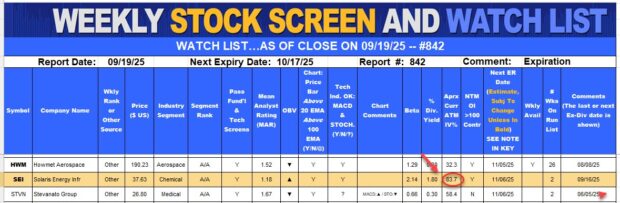
- Note the IV of 83.7% (circled with red arrow)
Real-life trade with SEI on 9/22/2025
- SEI trading at $37.63
- The 10/17/2025 $25.00 put has a bid price of $0.21
- The $25.00 put shows a Delta of -0.0454 or a 4.5% risk of being subject to exercise at expiration
- SEI next ER date is 11/6/2025
The BCI Trade Management Calculator (TMC)
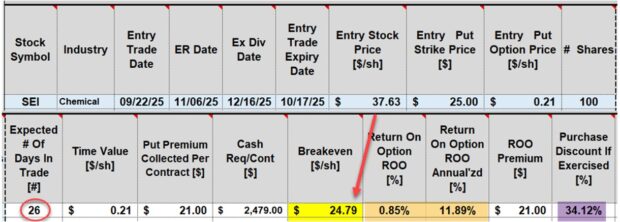
- Red circle: 26-day trade, if taken through contract expiration
- Yellow cell: Breakeven (BE) price is $24.79 from current market value of $37.63 (red arrow)
- Brown cells: Initial time value return is 0.85%, 11.89% annualized
- Purple cell: Downside protection to BE is a whopping 34.12%
- According to the Delta, the risk of being subject to exercise (without exit strategy intervention) is approximately 4.5%
Discussion
Even ultra-high IV securities can be used in our option portfolios in a low-risk manner, keeping our capital preservation goal in mind. In this case with SEI, the risk of exercise is only 4.5% with the potential of an 11.89% annualized return … singles and doubles, no grand slam homeruns. It is important to always remember that when we craft our trades defensively, rather than traditionally (strikes closer to current market value) we are trading potential returns for protection. However, the returns can still be significant while still benefitting from the downside protection.
Selling Cash-Secured Puts Basic and Advanced Principles: Online Video Course

This course contains 6- parts:
Section I: Option basics (definitions and foundational information)
Section II: Traditional put-selling (stock & option selection + position management)
Section III: PCP (wheel) strategy (adding covered calls to selling cash-secured puts)
Section IV: Buy a stock at a discount instead of a limit order (buy a stock at our target price or get paid not to buy the stock)
Section V: Ultra-low-risk put/Delta strategy (High probability, low-risk trades)
Section VI: Ultra-low-risk put/implied volatility strategy (High probability, low-risk trades)
Free training resources
Your generous testimonials
Over the years, the BCI community has been incredibly gracious by sending our BCI team email testimonials sharing stories as to what our educational content has meant to their families. Moving forward, we have decided to publish several of these testimonials in our blog articles. We will never use a last name unless given permission:
I just ordered the TMC Package. The webinar last night was excellent! Really good job. I look forward to using the TMC!
Market Misbehavior Interview (David Keller)
1. Las Vegas Money Show- 2 presentations
February 23 – 25, 2026
The Collar Strategy: Covered Call Writing with Protective Puts
Protecting covered call trades from catastrophic share loss
This is the strategy Bernie Madoff pretended to use. He called it the split strike conversion strategy, but it was simply a collar. The covered call sets a ceiling on the trade and the protective put guarantees a floor on the trade
Topics discussed
- What is the collar strategy?
- Uses for the collar
- Entering a collar trade
- Option basics for calls
- Option basics for puts
- Real-life example with NVDA
- What is an option-chain?
- Real-life example using the BCI Trade Management Calculator (TMC)
- Strategy pros & cons
- Educational products & discount coupon
- Q&A
Selling Cash-Secured Puts to Buy a Stock at a Discount or to Enter a Covered Call Trade
2 outcomes & 4 applications
Selling cash-secured puts is a low-risk option-selling strategy which generates weekly or monthly cash-flow. This presentation will detail how to craft the strategy to generate cash flow, buy a stock at a discounted price or to initiate a covered call trade. Topics included in the webinar include:
- Option basics
- The 3-required skills
- 4-practical applications
- Traditional put-selling
- PCP (Put-Call-Put or wheel) Strategy
- Buy a stock at a discount instead of setting a limit order
Real-life examples along with rules, guidelines and calculations are included in this presentation.
Time, date & registration link.
2. Palm Beach Traders Club
March 10, 2026
6:30 PM – 8 Pm ET
Private Investment Club / guests are welcome (free)
Wine-tasting event follows for those interested.
3. Long Island Stock Investors Meetup Group: Part II
Thursday March12, 2026
7:30 PM ET – 9:00 PM ET
Ultra-Low-Risk Approaches to Covered Call Writing & Selling Cash-Secured Puts
Introducing Our Latest Products, Creating New Investment Opportunities
4. Hollywood Florida Money Show
April 10, 2026
11:40 AM – 12:25 PM
The Put-Call-Put (PCP) or Wheel Strategy
Using Both Covered Call Writing and Put-Selling to Generate Monthly Cash Flow
Selling stock options is a proven way to lower our cost-basis and beat the market on a consistent basis. Two such low-risk strategies are covered call writing and selling cash-secured puts. This presentation will detail how to incorporate both strategies into one multi-tiered option-selling strategy where we either generate cash-flow or buy a stock at a discount. I refer to this as the Put-Call-Put (PCP) Strategy, also referred to as the wheel strategy.
The basics and pros and cons of low-risk option-selling strategies will be discussed as well as an analysis of a real-life example and introduction into the BCI Trade Management Calculator (TMC). This seminar is appropriate for those who look to generate modest, but consistent, returns which will enable us to potentially beat the market on a consistent basis while focusing on capital preservation.
More details to follow.
5. Young Investor’s Club at The University of Central Florida
April 16, 2026
Private student investment club.
6. Sarasota Investment Group
Portfolio Overwriting: A Form of Covered Call Writing
Wednesday April 22, 2026
Details to follow.
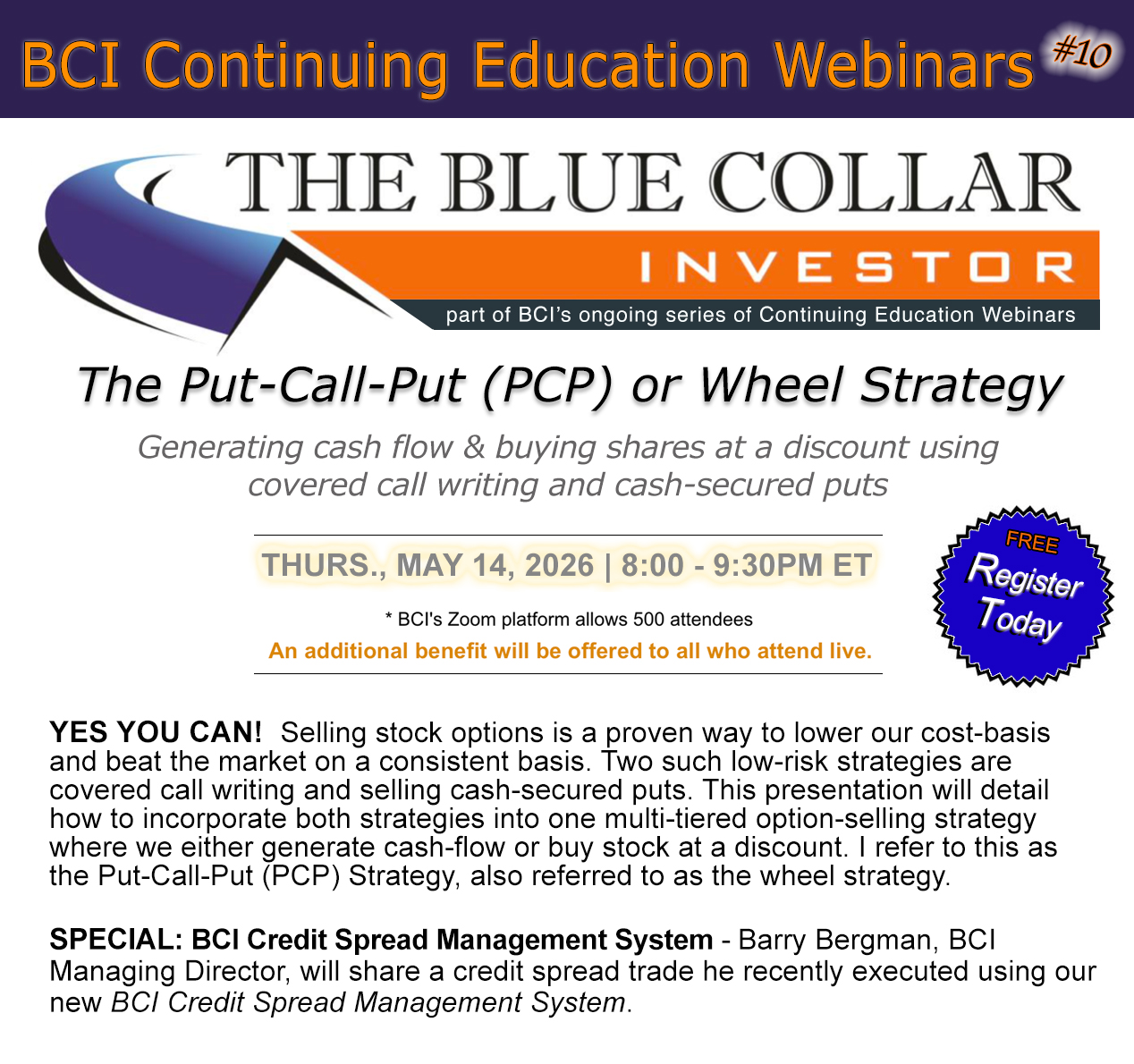
7. BCI Educational Webinar #10: The Put-Call-Put (PCP) or “Wheel Strategy”
Thursday May 14, 2026, at 8 PM ET
Using both covered call writing & cash-secured puts in a multi-tiered option selling strategy. A 68-day real-life example taken from one of Alan’s portfolios will be analyzed.
BONUS: Barry will share a real-life credit spread trade using our BCI Conservative Credit Spread Management System.
Discount coupons and a live Q&A session will follow the presentation.
8. Orlando Money Show
October 5 – 7, 2026
Details to follow.



Hi Alan,
Hope you are doing good.
I am a premium member and I use TMC for managing my trades. I found an interesting calculation in TMC this week. Here is the TMC calculation and my question is right below the information.
My trades (roll up)
aapl trading at 265 on 2/2/26.
STO aapl 2/20/26 265 put on 2/2/26 for 5.62.
aapl trading at 279 on 2/10/26.
BTC aapl 265 put on 2/10/26 for .68.
STO aapl 2/20/26 272.5 for 1.68 (Rollup)
aapl trading at 255.78 on 2/13/26.
when I enter 255.78 as my price at exercise TMC shows 662 as my option profit and 900 as my stock loss. This looks in correct to me. My stock loss should be 272.5 – 255.78 =16.72.
Looks like TMC is taking 265 as my cost basis at assignment .
Kindly let me know your thoughts on this TMC calculation? Am i missing anything in data entry?
Thanks
Kalyan
Kalyan,
Is exercise on 2/13 or 2/20?
Was AAPL trading at $272.50 or $265.00 at trade entry?
Both were unclear from the information you sent.
Regarding the expiration date, the calculations will be the same except when annualized. This relates to possible data entry errors.
Let’s assume AAPL was trading at $272.50 when you entered the trade. With CSPs, we don’t buy the shares at that price. They are assigned at the put strike, $265.00 in this scenario, so an unrealized loss of $922.00 is accurate.
If the expiration date is 2/20/2026, this trade is ongoing.
Let me know if you need further clarification.
You’re doing great!
Alan
Premium Members,
This week’s Weekly Stock Screen and Watch List has been uploaded to The Blue Collar Investor Premium Member site and is available for download in the “Reports” section. Look for the report dated 02/13/26.
Be sure to check out the latest BCI Training Videos and “Ask Alan” segments. You can view them on The Blue Collar YouTube Channel. For your convenience, the link to the BCI YouTube Channel is:
https://www.youtube.com/user/BlueCollarInvestor
Barry and The Blue Collar Investor Team
Hi Alan,
Thank you very much for the work that you do in educating us blue collar investors. Can you please share your thoughts on something that has been bothering me ever since I started trading covered calls. I thought that by now I would have come to some resolution, but unfortunately, I have not.
The allure of capital appreciation and covered call income is particularly appealing to me. With that mindset, my bias has always been towards selling OTM calls. I am a huge fan of your “Ask Alan” segment on the member site so I also understand that there is a place for selling ITM calls.
Some describe the covered call strategy as a directional trade. With that, one of my personal goals is to get the direction (market and equity) right. This is not always an easy task. Often, I ask myself. Why am I trading covered calls in a bear, or even in a neutral market? After all, if I earn covered call income but lose on the equity side of the trade, that is hardly a win. To me, the point is not to earn income, but rather to increase the value of my portfolio. I understand, that events like hitting a double or a triple can increase the value of one’s position even if the stock price decreases. Overall though, it does seem to me to be like a lower probability outcome than trading OTM covered calls in uptrending markets only.
Thanks for your time Alan,
Best Regards,
Edmund
Edmund,
Thanks for your premium membership and excellent questions. Let’s break down your comments and questions:
1. You favor OTM covered calls to generate 2 income streams (could be 3, if there is dividend income).
Me too, in normal to bull markets, we should always seek more than 1 income stream by favoring OTM covered calls. Since the market averages going up 8-10% a year, the majority of our trades will be of this nature.
2. There is a place for ITM covered calls.
You bet, in bear, uncertain and volatile markets, we may trade that second income stream for greater protection to the downside. This serves as an insurance policy of sorts. This is one of the approaches that sets us aside from everyone else selling covered calls … 1 size does not fit all. We are crafting our trades based on overall market assessment and personal risk-tolerance. Stated differently, we are dictating how to trade in all market environments, not having the market dictate to us whether or not we should trade.
3. Trade covered calls in up markets only.
In all market environments, even in bear markets, there are always elite performers. Even in 2008, there were outstanding performers. We find those securities for our members. It is important to understand that we can “ladder” our strikes … use some OTM and some ITM, depending on the factors I alluded to above. I never hold all OTM or all ITM. It’s a mix determined by these factors.
One more important consideration: If we are concerned about the market, we can sell OTM cash-secured puts to generate income, without first buying the securities. We can even take an ultra-low risk approach using delta, implied volatility or both. You’ll find “Ask Alan” videos describing how this is accomplished.
It sounds like you’re on the right track for a successful future selling options.
Alan
Premium members:
This week’s 5-page report of top-performing ETFs, along with our sample trade of the week, has been uploaded to your premium site. The Select Sector SPDR section is now crafted to align with our streamlined (CEO) approach to covered call writing. The report also lists Top-performing ETFs with Weekly options, mid-week market tone as well as the implied volatility of all eligible candidates.
We have also included a sample trade taken from one of our BCI watchlists.
Premium member video link:
https://youtu.be/EXMO-KwZuJs
For your convenience, here is the link to login to the premium site:
https://www.thebluecollarinvestor.com/member/login.php
NOT A PREMIUM MEMBER? Check out this link:
https://www.thebluecollarinvestor.com/membership.shtml
Alan and the BCI team
Premium members,
The new Blue Chip (Dow 30) Report for the March 2026 contracts has also been uploaded to your member site. Look on the right side and scroll down to “B”
Alan
Hi Alan,
I have a CC trade that I was looking at today (2/18/26) but didn’t take as something didn’t seem right, or more accurately stated “seemed too good to be true”. I attached a couple screenshots and was wondering if you could take a look at it and tell me what, if anything, I was missing.
The ETF was EWW – IShares Mexico ETF. The Bid was $0 but it was showing $1.05 at the Mark & Extrinsic Value which also was the midpoint split from the $2.10 Ask. Maybe the MM wouldn’t have even made the trade but I have had all of my trades recently where they have taken the trade at, or near, the Mark.
If I had taken the trade my plan was to: 1) let the option expire, and then sell a March 85 or lower Call (no MAR 84 Strike); or 2) Let the shares get assigned which would have been the best outcome.
Hopefully you have enough info to make an analysis of the trade but let me know if you have any questions.
Thanks!
Joe
Joe,
When a proposed option trade seems too good to be true, it usually is.
When an option chain shows a bid price of $0.00, it is typically due to a lack of liquidity or a deep OTM strike with a short time to expiration.
Since the implied volatility of EWW is low, market makers and investors are not willing to spend any significant premium to buy these options. You will not receive $1.05. Unless a buyer arrives, willing to buy this option, this trade will not be executed. if it is (unlikely), it will be at a much lower price.
Yes, too good to be true.
Alan