

Calculating initial returns for our covered call writing & cash-secured put trades is intuitive and straightforward. For puts, we divide the premium by the difference between the put strike and the put premium:
% initial put return = [(put premium/ (put strike – put premium)]
When trade adjustment opportunities (exit strategies) are implemented, the accurate archiving and calculations of the trades can be somewhat challenging. Enter the BCI Trade Management Calculator (TMC). In this article, a real-life example with Howmet Aerospace Inc. (NYSE: HWM) will be analyzed demonstrating a series of put trades involving 2 exit strategies with 2 expiration dates. This trade was shared with me by a premium member.
Real-life example with HWM
- 1/22/2026: HWM trading at $221.00
- 1/22/2026: STO 1 x 1/30/2026 $210.00 put at $1.49 (9-day trade)
- 1/30/2026: HWM trading at $208.08, leaving the $210.00 strike now ITM
- 1/30/2026: BTC the 1/30/2026 $210.00 put strike at $2.00
- 1/30/2026: STO 1 x 2/6/2026 $207.50 put strike at $3.49 (roll-down)
- 2/6/2026: The $207.50 strike remains OTM and is closed at $0.04
Implementing the Trade Management Calculator (TMC) with Multiple Expiration Dates
The TMC can be utilized in a myriad of ways. Here’s how I do it:
When using multiple exit strategies with multiple expiration dates, we can use more than 1 TMC spreadsheet. The first spreadsheet is for the 1/30 expiration and the 2nd for the 2/6 expiration. Each contract expiration has 1 STO & 1 BTC. You will note that the 1st shows a net debit of $51.00; the 2nd, a net credit of $345.00, resulting in a net credit of $294.00. More on this later.
TMC Spreadsheet for the 1/30/2026 Expiration
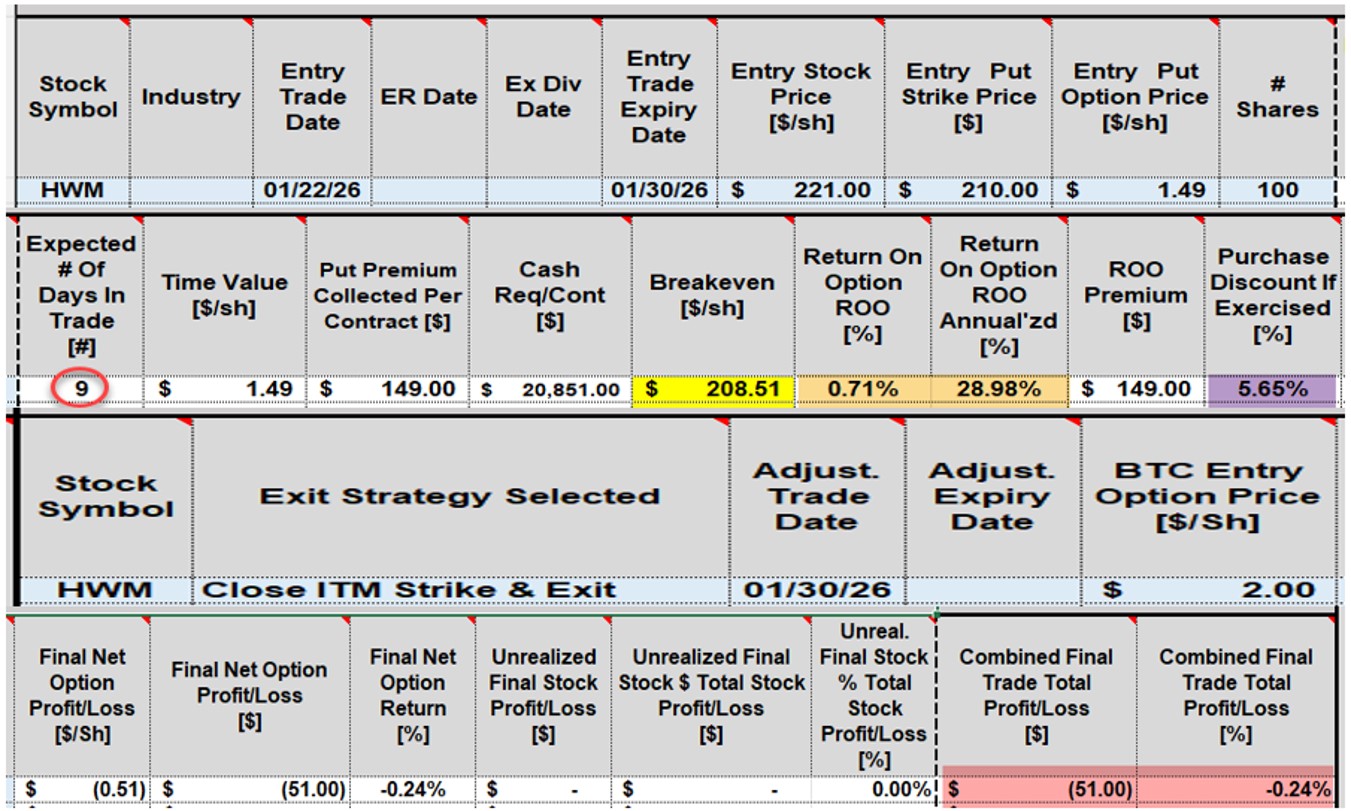
- Red circle: This is a 9-day trade if taken through contract expiration
- Yellow cell: The breakeven price point (BE) is $208.51
- Brown cells: The initial 9-day return is 0.71%, 28.98% annualized
- Purple cell: If HWM drops below the $210.00 strike and the put is not bought back (closed), shares will be purchased at a 5.65% discount (the BE price)
- Pink cells: After closing the option at $2.00, there is a net option loss of $51.00 or 0.24%
TMC Spreadsheet for the 2/6/2026 Expiration: HWM closes at $222.60
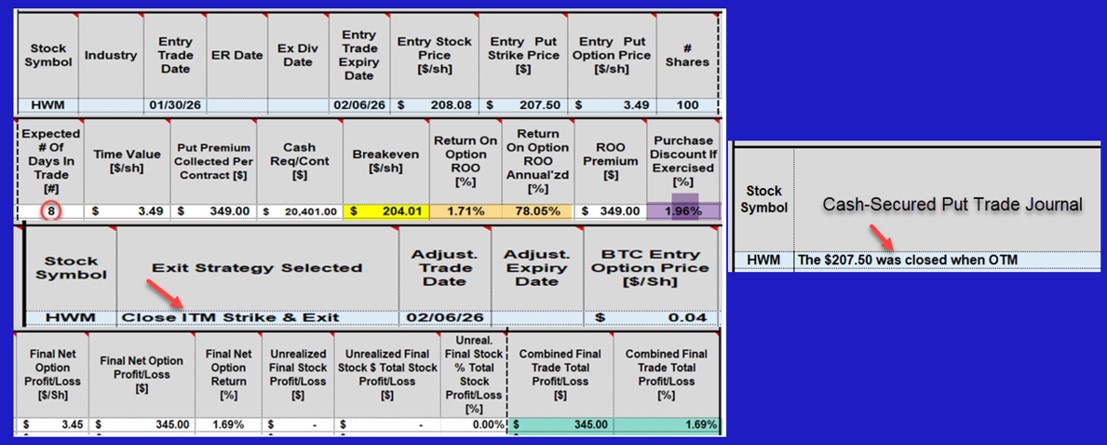
- Red circle: This is an 8-day trade if taken through contract expiration
- Yellow cell: The breakeven price point (BE) is $204.01
- Brown cells: The initial 8-day return is 1.71%, 78.05% annualized
- Purple cell: If HWM drops below the $207.50 strike and the put is not bought back (closed), shares will be purchased at a 1.96% discount (the BE price)
- Green cells: After closing the option at $0.04, there is a net option gain of $345.00 or 1.69%
- Note that the current TMC does not include an exit strategy to close an OTM strike, something we are considering, even if this is rarely used. As an alternative, we can make a notation in the Trade Journal, as shown on the right side of the screenshot
Final Combined 16-Day Returns
- Net credit = $345.00 – $51.00 = $294
- Cost basis: $210.00 – $1.49 = $208.51
- % 16-day return = 1.41%
- Annualized return = 32.17%
- Note: There was no need to close the deep OTM $207.50 contract on 2/6/2026. But costs only $0.04, so no harm
Discussion
There are many ways the TMC can be utilized, based on your trading style and needs. One way is to identify each TMC spreadsheet by contract expiration date. The Trade Journal can be utilized to make notations that will be helpful when reviewing trades. The BCI Trade Management Calculator (TMC), calculates initial returns, allows for trade adjustments and is a fantastic learning tool
The New BCI Credit Spread Management System
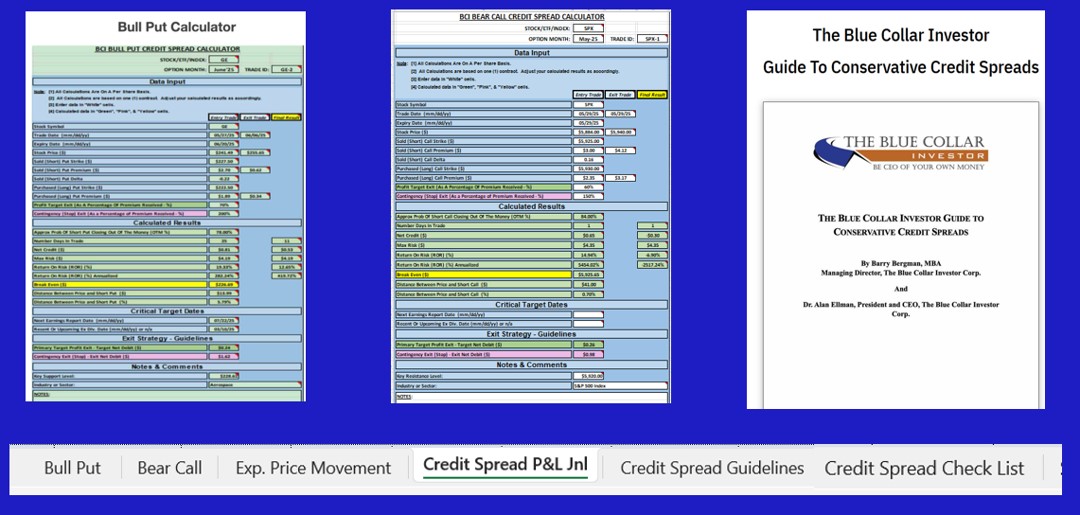
6-Tab calculator with context-sensitive help and the new BCI book, “The Blue Collar Investor Guide to Conservative Credit Spread Trading”
Your generous testimonials
Over the years, the BCI community has been incredibly gracious by sending our BCI team email testimonials sharing stories as to what our educational content has meant to their families. Moving forward, we have decided to publish several of these testimonials in our blog articles. We will never use a last name unless given permission:
Hello Alan,
I am a retired orthodontist and have read I think 3 of your books several times. In the last 10+ years I have been doing only PCP except for 5 months doing spreads. I had 100% of my money in tax free bonds at retirement. As interest rates fell, I was getting called a lot. I had lunch with my accountant and asked Joe what to do. He told me he was selling covered calls. I did not know what that was. I am now up 1,050,000$ at the end of last year.
Thank you so much!!
Woody
Sample trade video with ANET
1. MoneyShow Masters Symposium Las Vegas
Tuesday July 21, 2026
Caesars Palace Hotel, Las Vegas
Title: The Put-Call-Put (PCP) or Wheel Strategy
Subtitle: Generating cash flow & buying shares at a discount using covered call writing and cash-secured puts
Description:
Selling stock options is a proven way to lower our cost-basis and beat the market on a consistent basis. Two such low-risk strategies are covered call writing and selling cash-secured puts. This presentation will detail how to incorporate both strategies into one multi-tiered option-selling strategy where we either generate cash-flow or buy stock at a discount. I refer to this as the Put-Call-Put (PCP) Strategy, also referred to as the wheel strategy.
The basics and pros and cons are discussed as well as a real-life example and introduction into the BCI Trade Management Calculator (TMC). This seminar is appropriate for those who look to generate modest, but repeatable, returns which will enable us to beat the market on a consistent basis while focusing on capital preservation.
2. Mad Hedge Investor Summit
Wednesday September 16, 2026
12 PM ET – 1 PM ET
The Collar Strategy: Covered Call Writing with Protective Puts
Protecting covered call trades from catastrophic share loss
Protect our covered call trades by purchasing protective puts. This results in lower risk transactions, with lower, but still significant option returns. This is the strategy Bernie Madoff pretended to use. He called it the split strike conversion strategy, but it was simply a collar. The covered call sets a max gain and the protective put guarantees a maximum loss.
Topics discussed
- What is the collar strategy?
- Uses for the collar
- Entering a collar trade
- Option basics for calls
- Option basics for puts
- Real-life example with NVDA
- What is an option-chain?
- Real-life example using the BCI Trade Management Calculator (TMC)
- Strategy pros & cons
- Event offer
- Q&A
Registration link to follow.
3. Toronto Money Show
September 24 – 25, 2026
MaRS Center, Toronto Canada
4. Orlando Money Show
October 5 – 7, 2026
Hilton Orlando Lake Buena Vista
Details to follow.
5. American Association of Individual Investors: NYC Chapter
Date and time to be confirmed.
6. Triple Edge Investing Summit: Technical Analysis • Options Strategies • ETF Mastery
Saturday January 23, 2027
Zoom presentation
All-day paid event
All-day event hosted by 3 experts:
- Dr. Alan Ellman (options)
- Dr. Eric Wish (technical analysis)
- Les Masonson (ETFs)
Hosted by TraderLion University
Details to follow.

Begin additional segments text here (like testimonials, events, etc.)

Premium Members,
This week’s Weekly Stock Screen and Watch List has been uploaded to The Blue Collar Investor Premium Member site and is available for download in the “Reports” section. Look for the report dated 07/02/26.
Be sure to check out the latest BCI Training Videos and “Ask Alan” segments. You can view them on The Blue Collar YouTube Channel. For your convenience, the link to the BCI YouTube Channel is:
https://www.youtube.com/user/BlueCollarInvestor
Barry and The Blue Collar Investor Team
Good morning Alan,
Wanted to explain a strategy I’m thinking about relating to the stock LMND:
ON 8/5/25 I bought 100 shares @$48.10 still short term tax wise.
Current pre market price $ $71.30, so $2,320 unrealized gain.
OR when CALLED AWAY the strike price 65 minus the 55.60 ( stock price call sold) =$940 gain + $193 premium. TOTAL $1,133.
STO $65 CALL on 6/1/26 EXP 7/17/26. LMND was at $55.60 , premium 1.93.
I would like to retain the shares as 1) I’m bullish on stock, 2) don’t want to realize gain and pay tax.
So, let me know the good/bad on this particular trade thought ….
Say LMND stays about the price a few days away from 7/17 expiration. It will be ITM and called away on the 17 th.
About 3 months ago I had changed my Fidelity choice of shares to be sold to LAST IN, FIRST OUT. So if a day or 2 before expiration would it be advisable to purchase another 100 shares of LMND at around the 71.30 price, wait 2 days and have those higher price shares be called away ?
I would retain the original shares at cost basis $48.10, avoid the capital gains. AND still be able write future CALLS on the LMND at conservative deltas in order to keep shares.
Yes, this would be a wash type sale most likely with maybe a dollar or so difference, up or down from the 71.30 price.
I’m sure I’m missing something because this seems to me an easy way out without having to pay and buy to close the current call option.
Thanks
Neil.
Neil,
Since I am not a tax expert, I ask you to consider my response as a starting point, which needs to be confirmed by your tax advisor before acting on it.
Yes, this is possible with certain brokerages, Fidelity being one of them (Schwab and Interactive are also friendly along these lines).
The strategy is referred to as “specific tax lot identification” and you’re off to a good start by changing FIFO to LIFO.
Now, a couple of points you may want to consider:
1. If you take this action with broker approval (make sure you speak with your broker prior to expiration to confirm), you are not eliminating tax, just deferring it, because your shares remain in your account at the lower cost-basis.
2. Let’s say the price of LMND is still $71.30 as expiration nears and those newly acquired shares are provided at exercise, there is a loss of $6.30 per-share. The cost-to-close the $65 call would be $6.30 + a few pennies on expiration Friday. This is an alternative you may want to consider.
Good job changing FIFO to LIFO, putting yourself in a position to take advantage of “specific tax lot identification”.
Alan
Premium Members:
1. This week’s ETF Report has been uploaded to your member site. Login to the member site and scroll down on the left side to access the report.
ETF Report Video Link:
Explanation of the report format:
https://youtu.be/addf7Y54ixwput
2. I’ve attached to premium member emails 5-day, defensive cash-secured put trades with 3 strikes, using FTNT, an elite-performing stock at the time of the trades. I executed these trades on 7/6/2026, for the 7/10/2026 expirations. Since trade initiation, technology has been volatile. This is another excellent example of the significant protection offered by deep OTM put strikes. FTNT closed at $156.71 today, down $5.72 from trade entry. The current price is above all put strikes with 2 trading days remaining until contract expirations. I’m still in a comfortable position to realize the 28% – 40% annualized returns. As always, I remain prepared to execute exit strategies, if those opportunities arise.
3. Our loyalty pledge to you: Premium members will NEVER experience a rate hike as long as premium member subscriptions remains active … NEVER.
4. New Quasar Markets interview:
(21) Quasar Markets on X: “Alan Ellman talking #option strategies! https://t.co/qQ4Rg27TcV” / X
Wishing you the best results,
Alan & the BCI team