

Covered call writers know to avoid the “shiny object” of long-dated options total dollar premiums and to annualize the initial returns to get a fair assessment as to how much cash flow we are generating. But is that the only benefit of shorter-dated options? In this article, I will make a case that there are additional benefits to shorter-dated options using a real-life example with iShares Bitcoin Trust ETF (Nasdaq: IBIT).
IBIT short & long-dated option chains
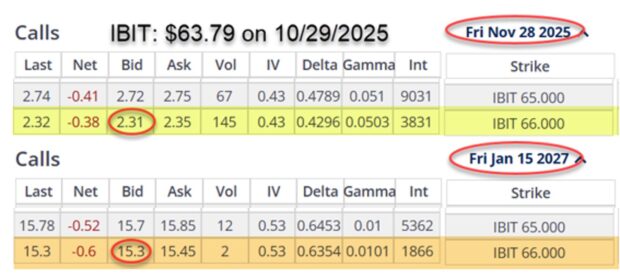
- The 1-month $66.00 call strike has a bid price of $2.31
- the 14-month $66.00 strike shows a bid price of $15.30 (the shiny object)
Calculating the short- and long-dated initial option returns using the BCI Trade Management Calculator (TMC)
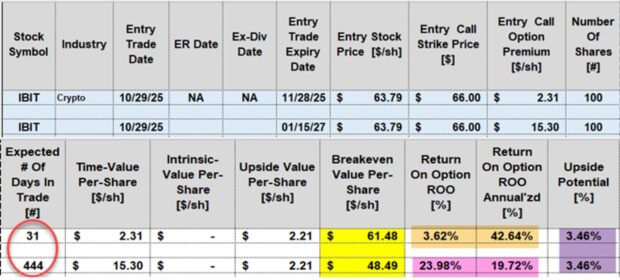
- The duration of the short and long-dated trades are 31 and 444 days, respectively
- The 31-day trade generates an initial time-value return of 3.62%, 42.64% annualized (brown cells)
- The 444-day trade (the “shiny object”) returns an initial time-value return of 23.98%, 19.72% (pink cells)
- The shorter-dated options more than doubles the annualized returns of the longer one
Additional advantages of short-dated options
Have a look in the purple cells of the TMC. The max additional profit we can generate from share appreciation is 3.46%. Using monthly or weekly options allows use to continually raise the OTM strikes (if bullish) and generate substantially greater returns on the stock side of the trade. Share appreciation will not be capped at 3.46% over the next 444 days.
Another advantage is that we will be able to re-evaluate our bullish assumptions regarding IBIT 12 – 52 times a year depending on if we are implementing weekly or monthly expirations
Discussion
When comparing the pros & cons of short versus long dated options, there is no contest. Short-dated options win in every way. We must put on our sunglasses and avoid the “shiny object” of the large initial cash premium, and we will be handsomely rewarded in the long run.
Click here for 2 videos (scroll down).
Free training resources
Your generous testimonials
Over the years, the BCI community has been incredibly gracious by sending our BCI team email testimonials sharing stories as to what our educational content has meant to their families. Moving forward, we have decided to publish several of these testimonials in our blog articles. We will never use a last name unless given permission:
Hi Alan,
Sincerely,
Phil
1. Hollywood Florida Money Show
April 8: Trading Panel
April 9: 2-hour Master Class
3:30 – 5:30
The Put-Call-Put (PCP) or Wheel Strategy
Using Both Covered Call Writing and Put-Selling to Generate Monthly Cash Flow
Selling stock options is a proven way to lower our cost-basis and beat the market on a consistent basis. Two such low-risk strategies are covered call writing and selling cash-secured puts. This presentation will detail how to incorporate both strategies into one multi-tiered option-selling strategy where we either generate cash-flow or buy shares of stock at a discount. I refer to this as the Put-Call-Put (PCP) Strategy, also referred to as the wheel strategy.
The basics and pros and cons of low-risk option-selling strategies will be discussed as well as an analysis of a real-life example and introduction into the BCI Trade Management Calculator (TMC). This seminar is appropriate for those who look to generate modest, but consistent, returns which will enable us to potentially beat the market on a consistent basis while focusing on capital preservation.
April 10: Portfolio Overwriting
11:40 – 12:25
2. Young Investor’s Club at The University of Central Florida
April 16, 2026
Private student investment club.
3. Sarasota Investment Group
Portfolio Overwriting: A Form of Covered Call Writing
Wednesday April 22, 2026
Details to follow.
4. BCI Educational Webinar #10: The Put-Call-Put (PCP) or “Wheel Strategy”
Thursday May 14, 2026, at 8 PM ET
Using both covered call writing & cash-secured puts in a multi-tiered option selling strategy. A 68-day real-life example taken from one of Alan’s portfolios will be analyzed.
BONUS: Barry will share a real-life credit spread trade using our BCI Conservative Credit Spread Management System.
Discount coupons and a live Q&A session will follow the presentation.
5. American Association of Individual Investors: NYC Chapter
June 10, 2026, at 6 PM – 8 PM ET
More information to come.
6. Orlando Money Show
October 5 – 7, 2026
Details to follow.


Hey Alan,
Just found you on YouTube.
Have a question. When an option that you sell decays fast, do you buy it back and resell?
Is there a certain % you look for to buy back. Ive been using 80% and then sell again.
I try and pair up when I think my stocks are headed for a down turn using rsi and a heavier delta (15-20), then buying it back on the quick decay.
What do you think?
Elton
Elton,
Glad to help.
Let me start by saying that my trades are short-term to begin with … I use weekly and monthly expirations.
Now, I will buy back an option under 2 general circumstances:
Share price decline to mitigate losses. Perhaps you watched videos of mine discussing the 10%/20% guidelines, discussing when to close the short calls.
Significant share price acceleration to generate greater than a maximum return. The guideline here is we close both legs of the trade when we can generate at least 1% more than the time-value cost-to-close by contract ex[piration. My spreadsheets will do the calculations for us.
All this information is in my books and online video courses.
Alan
Premium Members,
This week’s Weekly Stock Screen and Watch List has been uploaded to The Blue Collar Investor Premium Member site and is available for download in the “Reports” section. Look for the report dated 03/13/26.
Be sure to check out the latest BCI Training Videos and “Ask Alan” segments. You can view them on The Blue Collar YouTube Channel. For your convenience, the link to the BCI YouTube Channel is:
https://www.youtube.com/user/BlueCollarInvestor
Barry and The Blue Collar Investor Team