

The Collar Strategy is a covered call writing-like strategy where a protective put is added to the trade, thereby establishing a floor and a ceiling with a maximum gain and a maximum loss. This article with analyze a real-life example NVDIA Corp. (Nasdaq: NVDA) to demonstrate how to implement this strategy.
Uses for the collar
- Protection in a contract period to protect during an earnings report (I, typically, avoid ERs completely)
- Protection during bear & volatile market conditions
- Reducing risk during uncertain times (Brexit, Fed announcement, elections etc.)
- Protecting appreciated stocks
- Insurance when we can’t be near a computer to monitor portfolios
Entering the 3 Legs of a collar trade
- Long stock (buy the shares first)
- Short (covered) out-of-the-money call (ceiling)
- Long out-of-the-money protective put (floor)
NVDA collar option chain
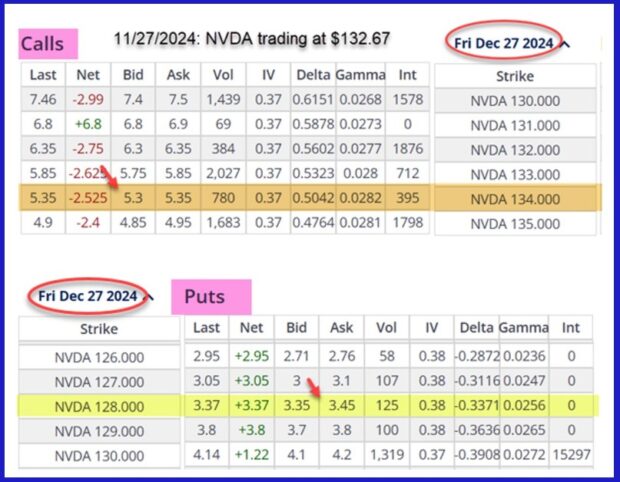
- NVDA trading at $132.67
- The $134.00 call (ceiling) has a bid price of $5.30
- The $128.00 put (floor) has an ask price of $3.45
- The net premium that will be entered into the BCI Trade Management Calculator (TMC) is $1.85 ($5.30 – $3.45)- see red arrow below
Initial collar time-value calculations with the TMC
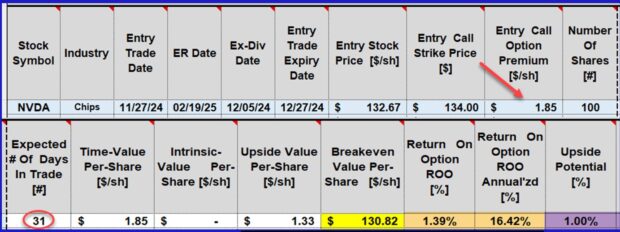
- Red circle: This is a 31-dqy trade, if taken through contract expiration
- Yellow cell: The breakeven price point is $130.82
- Brown cells: The 31-day initial time-value return is 1.39%, 16.42% annualized
- Purple cell: There is an additional opportunity of 1% share price appreciation
NVDA Collar Pros & Cons
Advantages
–Protects against catastrophic share loss below the $128.00 protective put strike
–Still results in a net option credit with an insurance policy
–Upside potential remains the same (1%)
–Sleep better at night?
Disadvantage
–Initial time-value return is reduced from 3.99%, 47.04% annualized to 1.39%, 16.42% annualized
Discussion points
- The collar strategy adds a protective put to our covered call trades
- Protects us against overwhelming share price decline
- Time-value returns will be lower than traditional covered call writing in exchange for the added protection
- Our collar trades can be managed by the BCI Trade Management Calculator (TMC)
- We do so, by deducting the put premium debit from the call premium credit
- We can establish both initial and final calculations using this spreadsheet
- The short call is the active management leg of the trade
Combining Exchange-Traded Funds with Stock Options
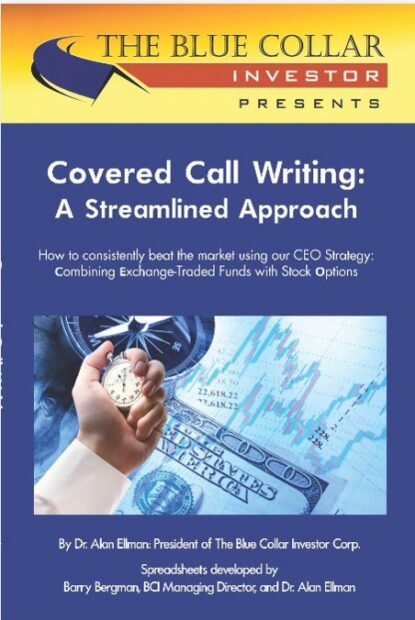
This book Is written for investors seeking a low-risk approach to generating cash flow in a user-friendly and time efficient manner. It utilizes covered call writing and then tailors the strategy to achieve the following goals:
- Sell options to lower our cost-basis
- Generate weekly or monthly cash flow with reduced but still significant initial percent returns
- Reduce the database of underlying securities available from 8500 to 11
- Reduce the number of exit strategy considerations from 14 to 4
- Beat the market on a consistent basis
- Reduce portfolio volatility
Click here for more information.
Your generous testimonials
Over the years, the BCI community has been incredibly gracious by sending our BCI team email testimonials sharing stories as to what our educational content has meant to their families. Moving forward, we have decided to publish several of these testimonials in our blog articles. We will never use a last name unless given permission:
Best to you.
Neil
Upcoming events
1. BCI Educational Webinar Series
Using Cryptocurrency in Our Low-Risk Option Portfolios
Thursday June 19, 2025 @ 8 PM ET
2. Cyber Trading Expo
Wednesday July 23, 2025
3 PM ET – 4 PM ET
Info & registration link to follow.
3. Orlando Money Show
Orlando Resort @ ChampionsGate
October 16 – 18, 2025
- Opening ceremony keynote address
- 2-hours Master’s Class
- 45-minute workshop class
Details and registration link to follow.



Alan,
Thank you for taking care of my annual premium membership.
Looks like I have a lot of studying to do with all the information you’ve included.
I have a question, please.
I thought I understood ITM strikes, but now I’m not so sure.
I bought the stock BROS on 6/5/25 for $73.21. Sold the 6/20/25 ITM option $70 strike with a premium of $4.80.
This gave me a profit of $1.59 with downside protection of 4.4% and breakeven of $68.41.
Today the stock is at $66.56.
So, does this mean that the stock would not be called away and I have a $73.21 stock at a cost of 68.41 ,with a share value as of today at $66.56, for a $1.85 loss per share.
If this is so, do I just let it expire and sell another BROS option next month or use a different exit strategy?
Hope I’ve explained my situation .
Thanks,
Ivan
Ivan,
If a call strike expires in-the-money at expiration (stock price at expiration > $70.00), even by $0.01, the shares will be sold at that strike price on the Saturday after expiration Friday.
If the stock price moves below the (original) ITM strike, leaving that strike now out-of-the-money, the option will expire worthless, and the shares will be retained.
The unrealized gain or loss depends on if the price is above or below $68.41.
It is important to include our 20%/10% guidelines with our covered call trades. This will partially automate the exit strategy process for us. Here’s a link of interest:
https://www.thebluecollarinvestor.com/application-of-the-20-10-guidelines-for-itm-otm-strikes-registration-form-for-thursdays-webinar/
I have this one as well. The final outcome is yet to be determined.
Keep up the good work.
Alan
Alan, hope all is well. Let me ask you about something I see as more terminology than anything else. that is rolling an option as opposed to buying back and selling the same.
My previous broker didn’t have the roll option available in trade……the current one does.
But I just have gotten in the habit of buying to close current option and selling to open the next. When I have tried to use roll w/ the current broker there is still the same 2 step process (but 1 execution) but I often seem to find I get better prices doing it my old buy then sell 2 step method.
I thought I should ask an expert and see if there something am missing and what do you advocate?
best,
JP
JP,
I’m with you 100% on this one.
I prefer the 2-step process as it allows for leveraging the “Show or Fill Rule”
We have some degree of control to get the best price execution for both steps of the exit strategy.
Alan
Thanks, as always for you reply and advice
jp
Premium members,
A new Blue Chip (Dow 30) Report for the best-performing Dow 30 stocks has been uploaded to your member site.
Login and scroll down on the right side (“resources/downloads”) and scroll to “B”
Tomorrow, we will also be adding a new ETF report and sending you a new sample “Alan Trade”
Alan & the BCI team
Premium members:
This week’s 4-page report of top-performing ETFs, along with our sample trade of the week, has been uploaded to your premium site. The Select Sector SPDR section is now crafted to align with our streamlined (CEO) approach to covered call writing. The report also lists Top-performing ETFs with Weekly options, mid-week market tone as well as the implied volatility of all eligible candidates.
We have also included a sample trade taken from one of our BCI watchlists.
Premium member video link:
https://youtu.be/EXMO-KwZuJs
For your convenience, here is the link to login to the premium site:
https://www.thebluecollarinvestor.com/member/login.php
NOT A PREMIUM MEMBER? Check out this link:
https://www.thebluecollarinvestor.com/membership.shtml
Alan and the BCI team