
Covered call writing can be used in conjunction with other strategies such as portfolio overwriting and dividend capture strategies. I have highlighted many of these covered call-related strategies in my books and DVDs. One of the strategies that has captured the interest of many of our members is the use of cash-secured puts. The cash-secured put involves writing (selling) a put option and simultaneously setting aside enough cash to buy the stock. The strategy can be used in one of three ways:
- Generate income from premiums (you do not want exercise)
- Purchase a stock for your portfolio “at a discount” (you would like exercise)
- To be used to enter a covered call position (either exercise or non-exercise will work well)
In today’s article I will focus in on a strategy that incorporates both cash-secured puts and covered call writing.
Overview of the strategy
We are bearish on the overall market or have a very low risk-tolerance and do not want to pay full price for the shares before writing our call options. Selling a put option at a lower price than current market value (this is out-of-the-money for puts) gives the put buyer (holder) the right to sell us the shares at this lower strike price. The option will be exercised if the price falls below the strike. If this occurs, we can then sell a call option on this “discounted” stock.
Diagram of the strategy
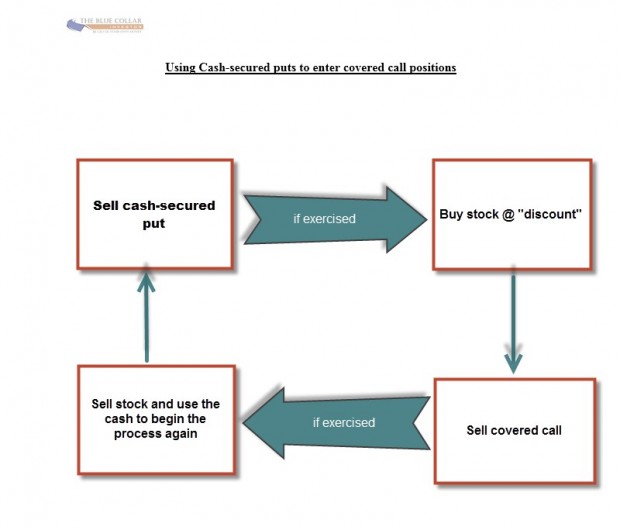
Cash-secured puts and covered call writing
Real life example of entering a covered call position “at a discount”
Here is a put options chain for EDU, a stock on our premium watch list as of 8-16-13:

Put options for EDU
The trade
- With EDU trading @ $22.50 we would like to buy it at $22
- Sell 1 x September (1-month out) $22 put, giving the option holder the right to sell you the stock @ $22
- Deposit $2200/contract into your brokerage account making the trade “cash-secured” or “covered”
- The initial return is $60/$2200 = 2.7%, 1-month return (must be monitored if price drops dramatically)
- If stock price drops below $22 by expiration we will buy shares @ $22
- Write covered call on newly acquired shares
Advantages
- Shares are acquired at a cost basis of $21.40 ($22 – $0.60), not $22.50
- If unexercised, we still generate a 2.7%, 1-month return
Disadvantages
- Maximum profit is put premium, no share appreciation
- Monitoring essential if share price declines dramatically (same for covered call writing)
- Must master the differences between calls and puts (in-the-money and out-of-the-money are inversely related for calls and puts)
Conclusion
Combining cash-secured puts with covered call writing is a viable strategy especially in bear market environments or if the investor has a low risk-tolerance. Before considering using this strategy an investor must master and understand the differences between call and put options. The same stocks that are great covered call writing candidates on our Premium Watch List are also great candidates for selling cash-secured puts.
Next live seminar:
October 19th, Los Angeles, California:
http://www.aaii.com/chapters/meeting?mtg=2523&ChapterID=5
My recent trip to Paris with Linda and friends Iris and Gary:

In the Louvre

Paris street cafe as common as McDonald’s in the US
Market tone:
Because of the partial government shutdown (don’t get me started), there were few economic reports available:
- Consumer credit (a report of the dollar value of consumer debt, including categories such as credit card use and store charge accounts (known as revolving debt) as well as longer-term loans for autos, education, recreation vehicles. The level of consumer credit is considered a barometer of consumers’ financial health and an indicator of potential spending patterns) in August rose $13.6 billion above analyst expectations of $12 billion
- Jobless claims for the week ending October 5th came in at 374,000, more than the 310,000 expected
- Minutes from the September Fed meeting highlighted that policy-makers agreed to delay tapering of the stimulus until the economy demonstrated sustained growth
For the week, the S&P 500 increased by 0.8% for a year-to-date return of 21%
Summary:
IBD: Uptrend under pressure
BCI: Moderately bullish but selling an equal number of in-the-money and out-of-the-money strikes until the government shutdown ends and the debt ceiling is raised
My best to all,
Alan (alan@thebluecollarinvestor.com)


Premium Members,
This week’s Weekly Stock Screen And Watch List has been uploaded to The Blue Collar Investor premium member site and is available for download in the “Reports” section. Look for the report dated 10-11-13.
Also, be sure to check out the latest BCI Training Videos and “Ask Alan” segments. You can view them at The Blue Collar YouTube Channel. For your convenience, the link to the BCI YouTube Channel is:
http://www.youtube.com/user/BlueCollarInvestor
Since we are entering Earnings Season, be sure to read Alan’s article, “Constructing Your Covered Call Portfolio During Earnings Season”. You can access it at:
https://www.thebluecollarinvestor.com/constructing-your-covered-call-portfolio-during-earnings-season/
Best,
Barry and The BCI Team
Hi Alan, I am not really into selling put options myself, but have sort of considered the buying of put options as a way to protect from losses.
My questions are:- If I buy put options for protection and I sell them back for more than before, then does this reduce my cost basis, – or only if share price goes back up to make a profit?
– And does buying a put option improve my return if price has dropped?,- can you give me an example – as well as for the overall return? Thanks
Fred,
For tax purposes (always consult a tax expert for final investment decisions) buying a put increases your cost basis and selling a call reduces your cost basis. Adding up your credits and debits once all positions are closed from all three aspects of the trade (long stock, long put, short call) will determine capital gains (losses). Here is a link to an article I previously published on protective puts:
https://www.thebluecollarinvestor.com/protective-puts-the-collar-strategy/
Alan
Alan: In a previous article, you wrote that you did not favor selling puts as a method of acquiring stock on which to sell covered calls. What has changed your mind? I have sold CSPs successfully for many years, and if the stock was put to me, sold CCs. I was surprised that you were negative on the idea, and am pleased to see that you have apparently changed you mind. So, again, I ask, what caused that change?
Larri,
I have always favored covered call writing over selling cash-secured puts and still do. It has been working well for me and my family for 2 decades now. However, as I have stated frequently in my books/DVDs/blog articles/videos there are many ways to make money in the stock market. I have also stressed that education is power. That is why I have also written about LEAPS, protective puts, increasing dividend yield among many other subjects that I don’t necessary use as a main strategy in my portfolio. Many of the topics I write about are the result of member inquiry and suggestions and I am very much appreciative of this feedback as it has allowed me to write 4 books, over 300 blog articles and produce over 150 videos on these topics…I couldn’t have done it without you.
Selling c-s puts is a viable strategy for some investors and when parlayed with cc writing can be an outstanding strategy especially in bear market environments. I will continue to provide as much information as I can while responding to member inquiries and let you make the final decsions.
I’d love to hear from you regarding some of the trades you have made using both c-s puts and cc writing. I’m sure our members would as well.
Alan
Alan, while I have been papertrading I thought of some questions on calculating trade returns,etc I don’t think I fully understand, and these are:-
1. Is this 2-4%/m goal we are to go by, also to be used after you buyback the option to resell another one during the month, and also for roll-outs at end of month?(or is it limited to the initial selling of an option)?
2. Our total months returns, should this be before or after commissions are put on the trades?
3. In the book I remember you stating that sometimes in volatile markets we could leave a bit of cash on the sidelines. But how does one know the % to use?
4. Also if the portfolio overwriting of shares I read about gives higher returns in most market conditions, then how come you don’t use this strategy for selling options?
Looking forward to your advise again. (ps. I had my Qu’s of interest about weeklies in last blog article too.)Thanks
Fred,
The 2-4% per month is my personal comfort level and sweetspot for initial option returns. Some members who are more aggressive than I am shoot for higher returns with more volatile stocks and ATM strikes. In my mother’s account, I use ETFs where my goal is 1-2% for initial returns. The 2-4% also applies to rolling options as expiration approaches. If I close a position mid-contract and enter a new one, my goal decreases as time value has eroded (theta) so it may be 1-2% perhaps.
I rarely have cash on the sidelines except for the 2-3% of total portfolio value for potential exit strategy opportunities. 2008, an aberration, is an example when I went to cash, late in the year.
Alan
New seminar:
Saturday July, 19, 2014
Arlington, Virginia
3-hour workshop sharing the stage with Dr. Eric Wish, Professor at the University of Maryland
Details to follow
Alan
Running list stocks in the news:VRX:
Valeant Pharmaceuticals from Canada has been on the BCI Premium Stock list for 17 weeks and has been a top cash generator for many BCI members. It has built its brand through mergers and acquisitions like the recent purchase of Bausch & Lomb, making it the largest player in the eye care and opthamology arena. This strategy has led to 50% sales growth and 40% EPS growth and sigificant price appreciation over the past 4 months. Goldman Sachs recently upgraded this stock with a $130 price target. Our premium stock list shows an industry segment rank of “A” and a beta of 1. Analysts have become extremely bullish on this company as earnings estimates have been increasing quarter after quarter as shown in the screenshot below (CLICK ON IMAGE TO ENLARGE AND USE BACK ARROW TO RETURN TO BLOG):
Alan
Alan, the options expiration is in a few days and one of my papertraded shares is “pinning the strike price”. You say that if on expiry day the share price is pinning and you don’t want to be exercised that I should buyback the option,- but how do I know how close it should get to it(if price just OTM)?,- should I maybe look at buying back option if it gets within 1% or 2%,etc?(another example is p.116 of exit strategies book – on expiry day.)?
Also if at expiration the share price is below the strike price(from an OTM call option) but not pinning it, then is the best thing to do by just ‘taking no action’? (it wasn’t mentioned in your books)?
Just a bit unsure if I should buyback or TNA at all. Thanks
Fred,
As we approach 4PM EST on expiration Friday, the time value of the premiums approach zero. The cost to close a slightly out-of-the-money strike will be minimal especially if we have multiple contracts minimizing commission factors. That being said, if the goal is to keep the stock and the price is approaching the strike price by one half of 1% then the safe approach would be to roll the option. So if we sold a $30 call and the share price is $29.85 or more in the last half hour of trading, rolling would make sense. This is a guideline (the 1/2 of 1%).
Alan
hi alan , if i sell a cash secured put and the price of the share touches the required price for me to buy the stock can i purchase the stock before the expiration or do i have to wait until the specified date , eg if i sell the put xyz at 39.50 (the stock is currently 40.00) , a couple of days in the stock drops to 39.45 can i now purchase that stock at the agreed 39.50 so i can write a covered call straight away , if i have to wait then if the stock drops to 32.00 i will have to buy it for 39.50 , i will be down straight away . thanks for your help . Michael
Michael,
When we sell a c-s put, the option buyer (not us) has the right but not the obligation to exercise. We have no control over that aspect of the trade. Under most circumstances, if exercise were to occur it will be after 4PM ET on expiration Friday. You will know over the weekend if the shares were “put” to you and then you can decide on the cc writing stage of this strategy for the upcoming week.
Alan
Dear Alan, Can you sell a covered call + sell a covered put (at the same time) Say you already had the stock?
Say bought $20 stock (then old out of money call at $22) then sold a put (covered?) at 18$ = you would collect 2 premiums?
Question: Could you do that , what would the risks be?
Thanks and let me know,
Nathan
Nathan,
If we buy a stock at $18.00 and sell the $20.00 call, we have a covered call trade with an OTM strike.
Now, if we also sell the $18.00 OTM put, we are required to secure that put with cash:
[($18 – put premium) x 100 x # contracts]
The stock only “covers” us for the covered call aspect of the trade.
The risk is that we may be required to double our position on a declining stock if share price moves below the $18.00 strike. We may have exit strategies to mitigate but that is the general risk.
Alan