

When a covered call trade is expiring in-the-money (ITM), we may have an opportunity to retain the underlying shares by rolling-out or rolling-out-and-up. The latter is a more aggressive form of rolling. This article will scrutinize a series of real-life trades, shared by Bob, a BCI Premium Member, to demonstrate how to calculate and determine initial and final returns.
Bob’s trades with JPMorgan Chase (NYSE: JPM)
- 5/12/2025: Buy 700 x JPM at $246.04
- 5/12/2025: STO 7 x 6/27/2025 $282.50 calls at $0.89
- 6/27/2025 (expiration Friday): BTC 7 x 6/27/2025 $282.50 calls at $4.37
- 6/27/2025: JPM trading at $286.87
- 6/27/2025: STO 7 x 7/11/2025 $290.00 calls at $2.42 (rolling-out-and-up from the $282.50 strike)
JPM final calculations for the 6/27/2025 expiration (BTC aspect of rolling included)

- Section # 1: Initial trade entries in our BCI Trade Management Calculator (TMC)
- Section # 2: Initial trade calculations (0.36%, 2.81% annualized with 14.82% upside potential). The maximum return is 15.18%
- Section # 3: Trade adjustment with the BTC at $4.37 (1st leg of rolling-out-and-up)
- Section # 4: Final trade results after closing the short call shows a net unrealized (shares not sold) return of 15.18%. Typically, there is a loss of a few pennies when closing a deep ITM call as expiration approaches
JPM initial calculations for the 7/11/2025 expiration (STO aspect of rolling included)

- Section # 1: Initial trade entries
- Section # 2: Initial trade calculations (15-day return of 0.84%, 20.53% annualized, with upside potential of an additional 1.09%
***When rolling an option, I prefer to enter the cost-to-close in the original contract calculations and the sell-to-open rolling premiums in the later-dated contracts.
Discussion
When rolling a covered call trade out-and-up, the BTC of the original short call can be applied to the initial trade (my preference) or the rolled expiration. If the BTC debit is included in the later-dated contract, the premium amount entered will be the debit + the credit. In these trades, it would be a premium of -$4.47 + $2.42 = -$2.05. You can see how this would throw off the 20%/10% guideline calculations in our TMC. My preference is to include the BTC debit with the initial contract and the STO credit with the later-dated contract. Although the combined results are the same, the exit strategy buyback price points are easier to calculate. As a matter of fact, if managed this way, the TMC spreadsheet will do these exit strategy calculations accurately for us.
Combining Exchange-Traded Funds with Stock Options

This book Is written for investors seeking a low-risk approach to generating cash flow in a user-friendly and time efficient manner. It utilizes covered call writing and then tailors the strategy to achieve the following goals:
- Sell options to lower our cost-basis
- Generate weekly or monthly cash flow with reduced but still significant initial percent returns
- Reduce the database of underlying securities available from 8500 to 11
- Reduce the number of exit strategy considerations from 14 to 4
- Beat the market on a consistent basis
- Reduce portfolio volatility
Free E-book on covered call writing
Use in conjunction with our Beginners Corner free video series on covered call writing (Free training link above)
Your generous testimonials
Over the years, the BCI community has been incredibly gracious by sending our BCI team email testimonials sharing stories as to what our educational content has meant to their families. Moving forward, we have decided to publish several of these testimonials in our blog articles. We will never use a last name unless given permission:
Hi Alan,
1. Money Masters Symposium Sarasota Florida
December 1 – 3, 2025
Setting Up Option Portfolios Using Stock Selection, Diversification, Cash Allocation and Calculations
Analysis of 6 covered call writing trades
Minimize risk and maximize returns. These are our 2 main goals when crafting our option portfolios. There are several factors we can utilize which will put ourselves in an outstanding position to achieve these objectives. Here is a summary of those factors which will be addressed during this presentation:
- Select elite-performing stocks and ETFs
- Diversity stock positions as well as their industries
- Allocate a similar amount of cash per position
- Ensure that initial calculations align with strategy goals and personal risk-tolerance
- Once trades are entered, go into position management mode- be prepared for exit strategy opportunities
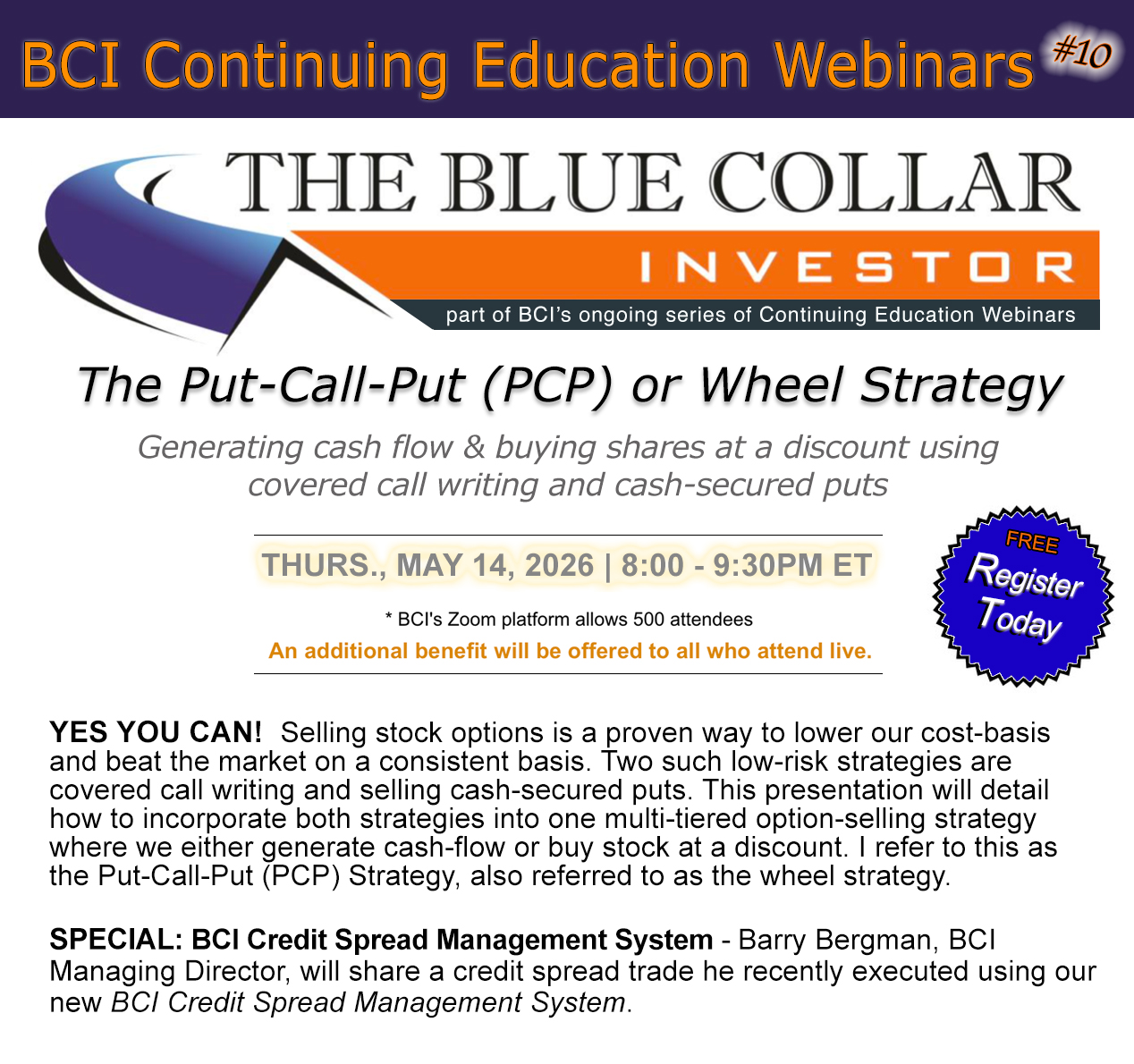
2. BCI Educational Webinar #9
Thursday January 15, 2026
8 PM ET – 9:30 PM ET
Topic, description and registration information to follow.
3. Long Island Stock Investors Meetup Group: Part I
Thursday February 12, 2026
7:30 PM ET – 9:00 PM ET
Topic, description and registration information to follow.
4. Las Vegas Money Show
February 23 – 25, 2026
The Collar Strategy: Covered Call Writing with Protective Puts
Protecting covered call trades from catastrophic share loss
This is the strategy Bernie Madoff pretended to use. He called it the split strike conversion strategy, but it was simply a collar. The covered call sets a ceiling on the trade and the protective put guarantees a floor on the trade
Topics discussed
- What is the collar strategy?
- Uses for the collar
- Entering a collar trade
- Option basics for calls
- Option basics for puts
- Real-life example with NVDA
- What is an option-chain?
- Real-life example using the BCI Trade Management Calculator (TMC)
- Strategy pros & cons
- Educational products & discount coupon
- Q&A
Time, Daste & Registration link to follow.
5. Long Island Stock Investors Meetup Group: Part II
Thursday March12, 2026
7:30 PM ET – 9:00 PM ET
Topic, description and registration information to follow.
6. Hollywood Florida Money Show
Details to follow.


Premium Members,
This week’s Weekly Stock Screen and Watch List has been uploaded to The Blue Collar Investor Premium Member site and is available for download in the “Reports” section. Look for the report dated 11/21/25.
Be sure to check out the latest BCI Training Videos and “Ask Alan” segments. You can view them on The Blue Collar YouTube Channel. For your convenience, the link to the BCI YouTube Channel is:
https://www.youtube.com/user/BlueCollarInvestor
Barry and The Blue Collar Investor Team
Netflix:
The 10-for-1 stock split took effect last week. Those of us who hold NFLX now own 10x the # of shares at 1/10 the previous value. No change in total value.
However, NFLX is now a more realistic candidate for covered call writing and cash-secured puts.
NFLX is NOT currently on our weekly watch list of elite-performing stocks, but frequently is, so let’s keep an eye out for its reappearance on our stock screen.
(About time!).
Alan
Good Morning Alan,
What about LEAPS?
John
John,
If you’re referring to LEAPS as the short call, yes, they can be rolled as well. Typically, the bid-ask spreads will not be favorable for our trade executions.
I advise against short, covered call LEAPS.
A few reasons include lower annualized returns, less opportunities to re-evaluate our bullish assumptions on the underlying security and less opportunities to adjust our strikes.
Big upfront premiums … yes. But too many negatives.
Alan
Alan:
Happy Thanksgiving!
I was curious how you handle this situation. I save a copy of the TMC for each month. Both sometimes, and occasionally frequently, I have a trade that has not met the expiration date by the end of the month. Here are my questions:
– Do you just go back to last month’s copy of the TMC and update it when it is finally closed? I don’t like this because I could potentially forget about the position and might miss an opportunity to roll up/down/out.
– Duplicate the trade in next month’s spreadsheet. My “issue” with this approach is how to get a good annual perspective of my performance as this trade could be counted twice. If this is the approach you take, how do you create/view a full year snapshot of all your trades?
Thanks in advance,
Don
Don,
I always keep a blank version of the TMC on my computer … TMC_BLANK.
If I’m entering a series of trades for the 12/19/2025 expirations, I save it as … TMC_12-19-2025.
After expiration, all spreadsheets go into a TMC Folder … neat, clean and preserves space.
Now, let’s say you have a trade where the underlying remains in your portfolio after expiration. The spreadsheet allows for price entry if not sold and will calculate both realized and unrealized returns for us through expiration.
The unsold price in then entered into a new TMC spreadsheet for the next contract expiration with the gain or loss to-date having been accounted for.
If your goal is also to track a trade through multiple contract cycles as, perhaps, a learning tool, you can note in the Trade Journal something like AAPL_1 and then AAPL_2. This will allow you to easily go back in time an access the history of each trade.
If your interest is to track your total portfolio through each time frame, we also have the Portfolio Setup and Results spreadsheets:
https://thebluecollarinvestor.com/minimembership/portfolio-setup-results-spreadsheets/
Let me know if I’ve adequately answered your questions.
Alan
Hi Alan,
I hope you’re doing well.
I’m using the BCI “Approximate Expected Price Movement Calculator” Excel file, and I have a question about the column “ATM Implied Volatility (IV)”.
In my trading platform, I see several different IV figures:
An overall IV for each expiration date (IVx% for the whole option chain), and
Individual Impl Vol values for each strike on both the call and the put side, including the strike that is closest to at-the-money.
I’m not sure which of these IV numbers you recommend using in the ATM Implied Volatility (IV) cell in your spreadsheet:
The general IVx for that expiration,
The Impl Vol of the ATM call,
The Impl Vol of the ATM put,
Or perhaps an average of the ATM call and put?
Could you please clarify what the best practice is according to your methodology?
Thank you very much for your guidance and for all your educational work – it’s helping me a lot.
Best regards,
Nir
Nir,
I look at the 2-3 closest-to-the-money call and put strikes and do an average in my head. To simplify, just average 1 closest-to-the-money call and put strike.
Alan
Hi Alan,
Thank you for the quick and clear reply. That makes perfect sense. I’ll use the IV from the closest-to-the-money call and put strikes (and average them), and for a bit more precision, I’ll look at the 2–3 closest strikes and average those as well.
Really appreciate your help.
Best regards,
Nir
Premium members:
This week’s 4-page report of top-performing ETFs, along with our sample trade of the week, has been uploaded to your premium site. The Select Sector SPDR section is now crafted to align with our streamlined (CEO) approach to covered call writing. The report also lists Top-performing ETFs with Weekly options, mid-week market tone as well as the implied volatility of all eligible candidates.
We have also included a sample trade taken from one of our BCI watchlists.
Premium member video link:
https://youtu.be/EXMO-KwZuJs
For your convenience, here is the link to login to the premium site:
https://www.thebluecollarinvestor.com/member/login.php
NOT A PREMIUM MEMBER? Check out this link:
https://www.thebluecollarinvestor.com/membership.shtml
Alan and the BCI team