

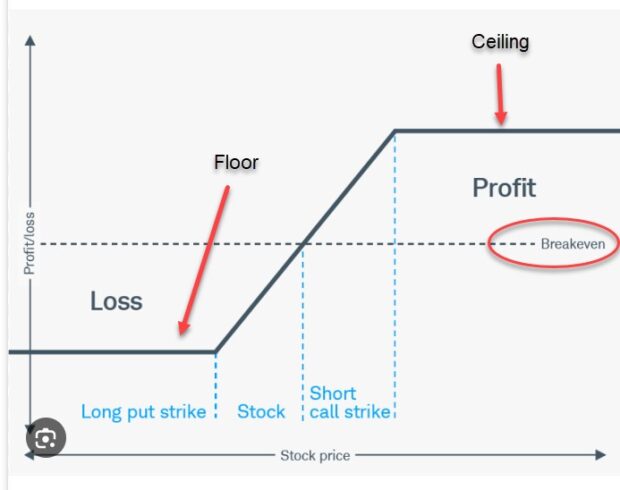
The collar strategy is a covered call writing-like strategy where a protective put is added to the covered call trade. Typically, an OTM call represents a ceiling to the trade (maximum gain) and an OTM put represents a floor (maximum loss). In this article, Invesco QQQ Trust (Nasdaq: QQQ), a technology exchange-traded fund (ETF) will be analyzed to explain how the collar strategy can be implemented.
Graphic representation of a collar trade
What is QQQ?
This is an ETF consisting of the top 100 non-financial corporations listed on the Nasdaq exchange. It includes companies like NVDA, AAPL, MSFT and AMZN.
Option chain data for QQQ on 12/8/2025
- QQQ trading at $623.90
- The $626.00 1/9/2026 call strike showed a bid price of $13.27 (ceiling)
- The $618.00 1/9/2026 put strike showed an ask price of $10.75 (floor)
- The goal is to have a net option credit, which is the case using these 2 strikes
Covered call calculations without the protective put using the BCI Trade Management Calculator (TMC)
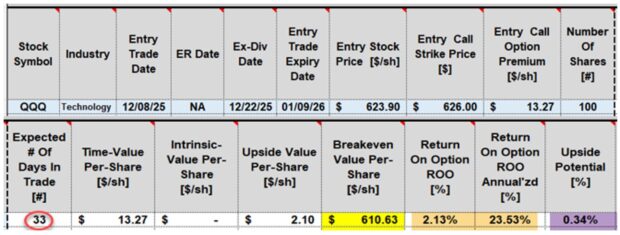
- Red circle: 33-day trade through expiration
- Brown cells: Initial return: 2.13%, 23.53% annualized
- Purple cell: 0.34% additional upside potential (if QQQ moves up to, or beyond the $626.00 strike)
Covered call calculations with the protective put using net option credit ($13.27 – $10.75 = $2.52
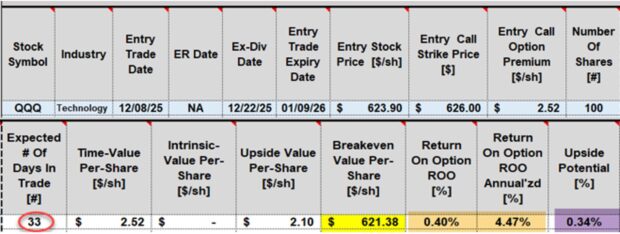
- Red circle: 33-day trade through expiration
- Brown cells: Initial return: 0.40%, 4.47% annualized (without upside potential)
- Purple cell: 0.34% additional upside potential
- The annualized return with upside potential is 8.2%
Discussion
Technology collar trades can be implemented by using QQQ and net option credits. The advantage is that we are eliminating catastrophic losses by including the protective puts. The disadvantage is that we are generating lower initial time-value returns, but with the same upside potential. To generate a higher collar return, a lower OTM call or OTM put strike will accomplish that goal.
Selling Cash-Secured Puts Basic and Advanced Principles
video course with downloadable workbook
This course contains 6- parts:
Section I: Option basics (definitions and foundational information)
Section II: Traditional put-selling (stock & option selection + position management)
Section III: PCP (wheel) strategy (adding covered calls to selling cash-secured puts)
Section IV: Buy a stock at a discount instead of a limit order (buy a stock at our target price or get paid not to buy the stock)
Section V: Ultra-low-risk put/Delta strategy (High probability, low-risk trades)
Section VI: Ultra-low-risk put/implied volatility strategy (High probability, low-risk trades)
Free training resources
Your generous testimonials
Over the years, the BCI community has been incredibly gracious by sending our BCI team email testimonials sharing stories as to what our educational content has meant to their families. Moving forward, we have decided to publish several of these testimonials in our blog articles. We will never use a last name unless given permission:
1. Sarasota Investment Group
Portfolio Overwriting: A Form of Covered Call Writing
Wednesday April 22, 2026
Details to follow.
2. BCI Educational Webinar #10: The Put-Call-Put (PCP) or “Wheel Strategy”
Thursday May 14, 2026, at 8 PM ET
Using both covered call writing & cash-secured puts in a multi-tiered option selling strategy. A 68-day real-life example taken from one of Alan’s portfolios will be analyzed.
BONUS: Barry will share a real-life credit spread trade using our BCI Conservative Credit Spread Management System.
Discount coupons and a live Q&A session will follow the presentation.
Click here for more information and to register (scroll down).
3. American Association of Individual Investors: NYC Chapter
June 10, 2026, at 6 PM – 8 PM ET
More information to come.
4. MoneyShow Masters Symposium Las Vegas
July 20 – 22, 2026
Caesars Palace Hotel
Las Vegas
Details to follow.
5. Toronto Money Show
September 24 – 25, 2026
MaRS Center, Toronto Canada
6. Orlando Money Show
October 5 – 7, 2026
Hilton Orlando Lake Buena Vista
Details to follow.


Premium Members,
This week’s Weekly Stock Screen and Watch List has been uploaded to The Blue Collar Investor Premium Member site and is available for download in the “Reports” section. Look for the report dated 04/17/26.
Be sure to check out the latest BCI Training Videos and “Ask Alan” segments. You can view them on The Blue Collar YouTube Channel. For your convenience, the link to the BCI YouTube Channel is:
https://www.youtube.com/user/BlueCollarInvestor
Barry and The Blue Collar Investor Team
Hi Alan,
Good Sunday here from a Sunny Netherlands.
As i am reading the book High Returns from Low Risk from Pim van Vliet following question comes to my mind.
Since i started with the CC approach i did not take Beta into such a high account in my investment decisions.
Is it wise to use more low Beta stocks in combination with CC in general? Is there any research on this topic about CC and low Beta stocks?
Have nice Sunday.
Kind regards,
Bas
Bas,
I consider implied volatility more important than beta as it relates to options trading.
Beta measures historical volatility and compares it to a benchmark. Typically, but not always, it is based on 1 or more years and compared to the S&P 500. I like beta for long-term buy-and-hold portfolios.
Implied volatility, on the other hand, is forward looking and based in option pricing in the marketplace. It is the projected, not the historical, measurement of price movement.
We do include beta stats in our Weekly Stock Screen & Watch List because our members asked for it, but I suggest focusing more on the IV column.
Alan
Thanks for your quick answer Alan.
If you want to select a more defensive portfolio you look at IV combined with Beta?
Bas,
Focus on the IV stats in our Weekly Stock Screen & Watch List, not beta.
Then use in-the-money covered calls and/or deep out-of-the-money cash-secured puts to structure the trade.
Make sure the initial returns align with your pre-stated initial time-value return goal range.
Following this blueprint will allow you to achieve your objective of establishing a defensive portfolio.
Alan
Alan,
Do you adjust the 3% guideline value for weekly options?
How strictly do you adhere to the 3% value?
Best regards,
William
William,
3% is a “guideline”, much like the 7% guideline on the stock side.
We know that not all trades will be winning ones, but if we adhere to the rules & guidelines of the BCI methodology, there will be many more winners than losers.
The 3% guideline sets a max loss on the losers. It can be slightly adjusted in either direction. This is why it is not referred to as a “rule” in our BCI methodology.
For weekly expirations or in the last week of a monthly contract, my guideline remains at 3% since the time-value cost-to-close the short put is approaching $0.00.
Bottom line: There will be a small % of losing trades in our portfolios. We don’t want a few substantial losers to overwhelm the majority of winning trades. Hence, the 3% guideline.
Alan
Premium Members:
1. This week’s ETF Report has been uploaded to your member site. Login to the member site and scroll down on the left side to access the report.
ETF Report Video Link:
Explanation of the report format:
https://youtu.be/addf7Y54ixwput
2. I’ve attached to premium member emails 2, 1-contract, 5-day covered call trades, 1 OTM & 1 ITM using MRVL as the underlying stock. I executed these trades on 4/20/2016, for the 4/24/2026 expirations.
One contract was defensive, the other aggressive. Significant initial returns, upside potential (OTM strike) and downside protection (ITM strike) were generated at the onset of the trades. This is an example of strike laddering I have been favoring. MRVL closed at $151.31 today, up $5.96 from trade entry. The current price is well above both strikes and breakevens. As always, I remain prepared to execute exit strategies, if those opportunities arise. So far, so good with these trades.
3. Our loyalty pledge to you: Premium members will NEVER experience a rate hike as long as premium member subscriptions remains active … NEVER.
4. New Quasar interview:
https://x.com/i/broadcasts/1qxoNewrrYvJv
5. Register now for our free BCI webinar on the PCP (Wheel) Strategy on May 14, 2026 (via Zoom):
https://www.thebluecollarinvestor.com/event/bci-educational-webinar-10/
Wishing you the best results,
Alan & the BCI team
Alan,
Could explain why someone would sell itm calls?
I’m thinking for the premium, and stick price appreciation?
Novice and confused
Steve
Steve,
Glad to clarify.
Mastering the skillset of strike selection is one of the factors that sets elite option traders apart from all the others.
Let’s look at the pros & cons of OTM vs. ITM covered calls:
OTM: Offers time value initial profit premium + the opportunity for additional profit from share appreciation from current market value up to the OTM call strike. Let’s say we buy a stock for $48.00 and sell the 1-month $50.00 call for $2.00. We have an initial return of 4.2% ($2/$48), with the possibility of another 4.2% if share price moves up to, or beyond $50.00 by expiation. The breakeven price is $46.00 ($48.00 – $2.00). The advantage of OTM covered calls is the potential for 2 income streams. We would favor OTM call strikes in normal-to-bull market environments.
ITM: Offers time-value initial profit + much greater protection to the downside (much lower breakeven prices). Let’s say we buy the same stock for $48.00 but this time sell the ITM $45.00 call for $5.00. This premium is NOT all profit because we are devaluing our shares by $3.00 (contractually obligated to sell at $45.00). This $3.00 component of the $5.00 premium is known as “intrinsic-value”, not profit, but lowers our breakeven prices. The remaining time-value initial profit is $2.00, the same as the OTM strike in this hypothetical. The breakeven price is $43.00 ($48.00 – $5.00). The advantage of ITM covered calls is a significant initial time-value return but greater protection to the downside. I would favor ITM covered calls in bear, volatile and uncertain market conditions or for those with a low personal risk-tolerance.
Bottom line: One size does not fit all. We can craft our trades to what’s going on in the market right now, not set every trade the same and ignore market conditions.
Let me know if my response clarifies this important issue.
Alan