

We write an out-of-the-money (OTM) covered call and share price moves up but does not breach the OTM strike by expiration Friday, so the option expires worthless. What price do we enter on Monday for the next expiration cycle? The original price, the price at expiration or the original price minus the original premium? This article will present a real-life analysis of such a scenario, using Bank of America Corp. (NYSE: BAC) to demonstrate the BCI approach.
Real-life example with BAC
- 12/1/2025: Buy 100 x BAC at $53.20
- 12/1/2025: STO 1 x 12/19/2025 $55.00 call at $0.61
- 12/18/2025: BTC 1 x 12/19/2025 $55.00 call at $0.06 (10% guideline). No opportunities to generate additional premium by rolling-down
- 12/19/2025: BAC trading at $54.11 as the contract expired
Initial calculations for the BAC trade
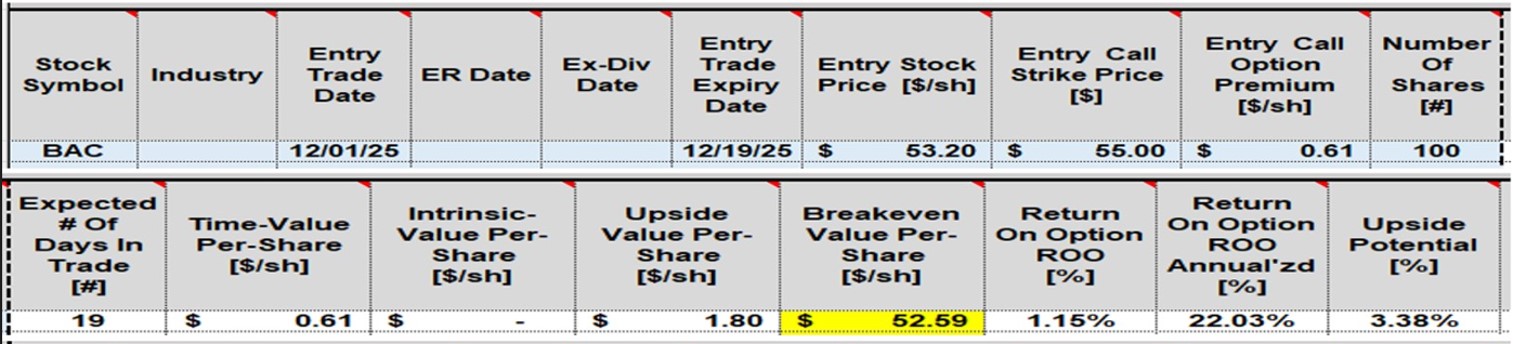
- The BCI Trade Management Calculator shows a 19-day return of 1.15%, 22.03% annualized
- There is an opportunity of an additional upside potential of 3.38%, if BAC moves up to, or beyond the $55.00 strike
Post-adjusted calculations for the BAC trade
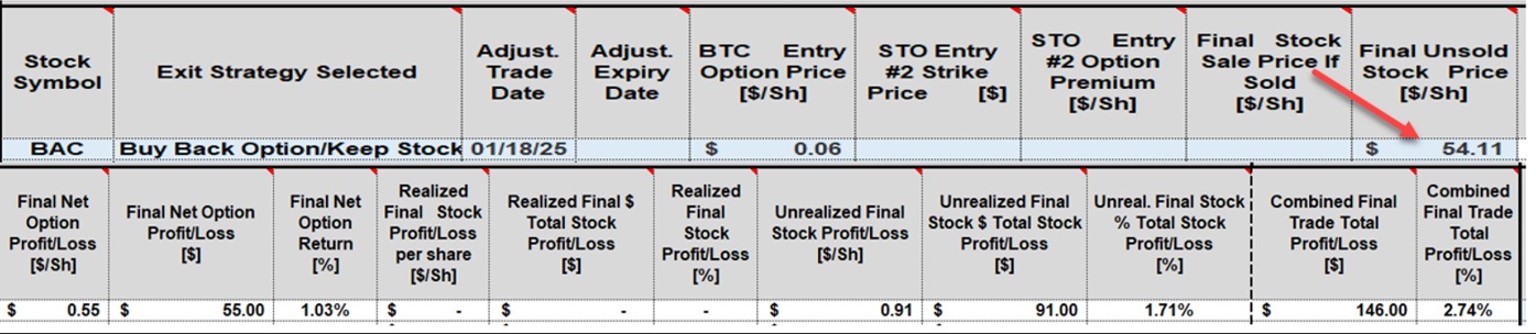
- There was share appreciation (unrealized, because shares are not yet sold) to $54.11 (from $53.20)
- The final realized option return was 1.03%
- The unrealized share return was 1.71%
- The final realized/unrealized net return for the 19-day period was 2.74%, 52.64% annualized
What cost-basis should we enter for the next contract cycle?
Since the shares are owned at $54.11 prior to market open, and the previous option profits were calculated for the last contract cycle, we will start with this price for the next cycle. If we didn’t write an option and just calculated share appreciation, we would use $54.11 because previous option and share appreciation were booked for the previous cycle. I do not like using the option profit twice, once to calculate returns and the other to lower cost-basis. I understand that other experts may have a different philosophical approach to the mathematics, but I’m happy to share the how and why of the BCI technique.
Discussion
When an OTM covered call expires worthless on expiration Friday, we use the closing price of the stock when entering our next trade on Monday. One final thought: If we don’t enter another call trade on Monday and wait an extended period of time to do so, use the current market value of the stock at the time of the trade.
Stock Investing for Students: A Plan to Get Rich Slowly and Retire Young
(Educating our youth to financial independence) – 12-Part VIDEO Series + 2 Companion PDF BOOKS
Self-investing starting at a young age can ensure a successful financial future and an early and comfortable retirement. So why is nobody doing this and taking advantage of the power of compounding? Change your thinking. Create a goal. Utilize the rich BCI methodology to facilitate your plan. Financial independence is achievable. Start today!
Click here for more information.
Free training resources
Your generous testimonials
Over the years, the BCI community has been incredibly gracious by sending our BCI team email testimonials sharing stories as to what our educational content has meant to their families. Moving forward, we have decided to publish several of these testimonials in our blog articles. We will never use a last name unless given permission:
New sample trade video:
1. Mad Hedge Investor Summit
June 3, 2026
12 PM ET – 1 PM ET
Covered Call Writing
Uncovering a 3rd Income Stream in Our Investment Portfolios
Increasing profits and avoiding tax issues using stock options
You have owned shares of stock in your non-sheltered accounts for many years. Share value has been appreciated significantly over time. This has put a smile on your face. Many of these securities have also generated dividend income. This, too, has pleased you. However, there is a 3rd income stream that you can activate right now, leveraging these same stocks, using a strategy known as covered call writing.
This is a low-risk option selling strategy analogous to generating rental income with a real estate investment property. Yes, renting out your stocks for limited periods. We have 2 goals: generate a 3rd income stream + retain the underlying shares to avoid negative capital gains issues.
This presentation will analyze how to implement this form of covered call writing, known as Portfolio Overwriting, always with capital preservation in mind.
2. American Association of Individual Investors: NYC Chapter
Date and time to be confirmed.
Via Zoom.
More information to come.
3. MoneyShow Masters Symposium Las Vegas
July 20 – 22, 2026
Caesars Palace Hotel
Las Vegas
Details to follow.
4. Toronto Money Show
September 24 – 25, 2026
MaRS Center, Toronto Canada
5. Orlando Money Show
October 5 – 7, 2026
Hilton Orlando Lake Buena Vista
Details to follow.
6. Triple Edge Investing Summit: Technical Analysis • Options Strategies • ETF Mastery
Saturday January 23, 2027
Zoom presentation
Paid event
All-day event hosted by 3 experts:
- Dr. Alan Ellman (options)
- Dr. Eric Wish (technical analysis)
- Les Masonson (ETFs)
Hosted by TraderLion University
Details to follow.


Premium Members,
This week’s Weekly Stock Screen and Watch List has been uploaded to The Blue Collar Investor Premium Member site and is available for download in the “Reports” section. Look for the report dated 05/22/26.
Be sure to check out the latest BCI Training Videos and “Ask Alan” segments. You can view them on The Blue Collar YouTube Channel. For your convenience, the link to the BCI YouTube Channel is:
https://www.youtube.com/user/BlueCollarInvestor
Barry and The Blue Collar Investor Team
Hi Alan,
This week i was in a CSP set up with TER. I opened it up on tuesday for the friday ahead with a 0.25 Delta.
Due to some volatility the strike price went down the 3% rule so i closed it up with a loss. After that it recovered.
TER is on the list again and i do not have any chips in my portfolio anymore so i am looking to open a CSP on it again.
This time i consider going down (a lot) and let it run for about one month (i guess the weeklies are just to volatile for me and a bit hard to manage….)
If you are going into a CSP trade, what is the general Delta you start with? I am considering to lower it down to about 0.15 or 0.20 and let the trade run for about a month…
What are your thoughts on this?
Greetings from sunny NL Bas
Bas,
The most appropriate strikes for our defensive monthly cash-secured put trades can be identified by factoring in these 2 metrics:
1. What is our pre-stated initial time-value return goal range?
2. How much risk (of exercise) are we willing to incur?
Here’s an example:
Let’s say our monthly goal for initial time-value returns is 2% – 4%. We then check the option-chain and identify the strikes that will generate returns within this range. Use the BCI Trade Management Calculator (TMC) to “run the numbers”.
Each strike will have an associated delta (risk factor). Select the combination of delta and initial returns that align best with your personal risk tolerance.
Following this blueprint will allow us to identify the most suitable strikes and their associated deltas.
Alan
Premium Members:
1. This week’s ETF Report has been uploaded to your member site. Login to the member site and scroll down on the left side to access the report.
ETF Report Video Link:
Explanation of the report format:
https://youtu.be/addf7Y54ixwput
2. I’ve attached to premium member emails a 2, 1-contract, 24-day (1 aggressive and 1 defensive) covered call trades, with ORA, an elite-performing stock at the time of the trade. I executed this trade on 5/26/2026, for the 6/18/2026 expiration. ORA closed at $139.69 today, up $5.88 from trade entry. The current price is near the OTM $140 strike and well above the ITM $125 strike with 3 1/2 weeks remaining until expiration. As always, I remain prepared to execute exit strategies, if those opportunities arise. Off to an excellent start, but a long way to go.
3. Our loyalty pledge to you: Premium members will NEVER experience a rate hike as long as premium member subscriptions remains active … NEVER.
4. New Quasar markets interview:
https://www.youtube.com/watch?v=tDPHDFNQGQw
Wishing you the best results,
Alan & the BCI team
Alan,
Being a newbie to options, I’m sticking with covered calls for a while.
But I have a question I can’t seem to get an answer to, or at least I could not find it on the website.
Why would I write a call with a strike price below the current market price (in the money?) ?
Would it not be exercised immediately?
Hypothetical trade. XZY mkt price 100.00
CC strike of 95.00
Seems to me that would get exercised immediately.
You guys have been great about answering my questions.
Thanks,
Steven
Steven,
I thought the same thing when I started with options. The fact is that early exercise (before expiration) is extremely rare and when it does occur, it is usually associated with ex-dividend dates. Even then, it’s unusual.
There are multiple reasons why early exercise of ITM covered calls is uncommon. I’ll give you 2 of the main reasons:
1. Options buyers, typically want to be option sellers, not share owners. They hope to be directionally correct and receive big payoffs.
2. Let’s go to your example and analyze the option premium associated with that $95 call option. ITM calls have 2 premium components: intrinsic-value (amount the strike is lower than current market value) + time or extrinsic-value (based on implied volatility of the stock and time-to-expiration).
In your example, the $95 call is $5 ITM, so that the intrinsic-value component. Let’s assign $2 for the time-value (could be more or less, but it’s something).
So, $5 + $2 = $7 is the value of e $95 call.
Now, the option buyer can exercise and capture the intrinsic-value of $5, buying at $95 when shares are worth $100, for an unrealized profit of $5.
Or sell the option for a credit of $7.
$7 or $5?
Good question. Love your due diligence.
Alan