

We can use put options as a hedge against share price decline of our long stock positions. This may be particularly useful after exponential price acceleration, and we want to protect our unrealized gains. This would represent an insurance policy that costs money. The debit for this protection can be partially or totally negated by simultaneously selling covered call options. The 3 components of this trade are collectively known as the collar strategy and when the net debit or credit approaches zero, the trade is known as a zero-dollar collar.
Components of a collar
- Own 100 shares of the underlying security (stock or exchange-traded fund) per contract
- Sell (usually) an out-of-the-money call option
- Buy (usually) an out-of-the-money put option
- The net premium can be a debit, credit or break even
What is a zero-dollar collar?
- This is a collar where the premium generated from the call option is equal to or nearly the same as the cost of the put premium resulting in a low-cost or no cost scenario on the option side
- If this can be accomplished, we can then benefit from continued, but limited, share appreciation at little or no cost, while enjoying protection to the downside
- This strategy can be particularly useful for those trading with securities that were purchased at significantly lower prices than current market value
A real-life example with NVIDIA Corp. (Nasdaq: NVDA): Calculations with our Trade Management calculator (TMC)
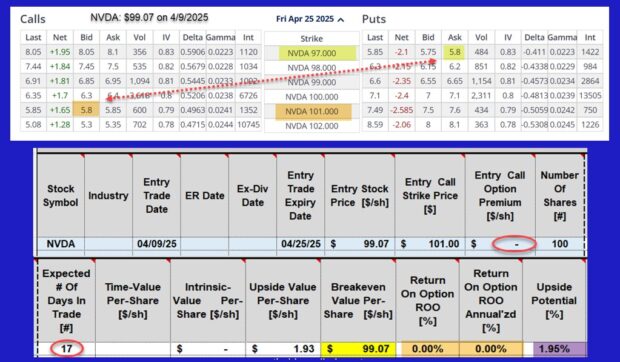
- NVDA trading at $99.07
- Broken red arrow: option credit/debit = $0.00 (red oval), using the $101.00 call (brown cell) and the $97.00 put (yellow cell)
- Brown cells: No option credit or debit
- Purple cell: 1.95% upside potential if share price moves from $99.07 to the $101.00 call strike in this 17-day trade
Have our 3 goals been accomplished?
Provide downside protection against a substantial loss in share value
Yes. We are protected against any share depreciation below the $97.00 put strike. We are susceptible to share decline from $99.07 down to the $97.00 strike but no more than that.
Provide an opportunity of limited share appreciation from current market value up to the call strike price
Yes. We retain the potential for share appreciation from $99.07 up to the $101.00 call strike. This would represent a 1.95% 17-day return or an 41.86% annualized return.
Result in a low or no-cost option collar or a zero-dollar collar
Yes. We have an option credit on the call side of $5.80 and also a put debit of $5.80 resulting in a zero-dollar collar.
Discussion
For those who have a portfolio consisting of low-cost basis securities the zero-dollar collar may be a useful tool. It is a no-cost way of generating protection against significant loss in share value while at the same time still offering an opportunity for share appreciation.
Selling Cash-Secured Puts
 Using stocks and stock options to develop a low-risk, wealth-building strategy for retail investors. Selling puts is a strategy similar to, but not precisely the same as, covered call writing. Mastering either strategy is a huge opportunity for retail investors to secure our financial futures. Mastering both will allow us focus in on the best investment choices depending on market conditions and personal risk tolerance.
The purpose of this book is to give the reader the tools to master a conservative stock and option strategy with the goals of generating monthly cash flow and focusing in on capital preservation. Selling cash-secured puts is a low-risk strategy that leverages high-quality stocks and exchange-traded funds to accomplish these objectives.
Your generous testimonials
Over the years, the BCI community has been incredibly gracious by sending our BCI team email testimonials sharing stories as to what our educational content has meant to their families. Moving forward, we have decided to publish several of these testimonials in our blog articles. We will never use a last name unless given permission:
Hello Alan and Barry,
Excellent video. Great lesson learned.
I study the three reports you send out every week and month, and so I just used different ways to decide my trades.
This video really breaks down the steps necessary.
Thank you.
Ketan (Premium Member)
Upcoming events
1.Mad Hedge Investor Summit
Tuesday September 9, 2025
11 AM ET
Details to follow.
2. BCI Educational Series Webinar # 8: New Credit Spread Calculator
Thursday September 18,2025
8 PM ET – 9:30 PM ET
Over the past 2 years, BCI has been developing and beta-testing a 1-of-a-kind spreadsheet for entering and adjusting our credit spread trades. Like our Trade Management Calculator (TMC), our goal was to make it the industry standard. Only you can decide if we accomplished our mission.
Alan & Barry will introduce this product, review all the tabs inherent in the spreadsheet and demonstrate how to use it. A 1-time early order discount will also be offered.
For those who trade, or are interested in learning how to trade, credit spreads, this is a must-see webinar.
Click here to register for free.
3. Orlando Money Show
Orlando Resort @ ChampionsGate
October 16 – 18, 2025
- Opening ceremony keynote address
- 45-minute workshop class: Traditional & Low-Risk Covered Call & Cash-Secured Put Trades
Details and registration link to follow.
4. Money Masters Symposium Sarasota Florida
December 1 – 3,2025
Setting Up Option Portfolios Using Stock Selection, Diversification, Cash Allocation and Calculations
Analysis of 6 covered call writing trades
Minimize risk and maximize returns. These are our 2 main goals when crafting our option portfolios. There are several factors we can utilize which will put ourselves in an outstanding position to achieve these objectives. Here is a summary of those factors which will be addressed during this presentation:
- Select elite-performing stocks and ETFs
- Diversity stock positions as well as their industries
- Allocate a similar amount of cash per-position
- Ensure that initial calculations align with strategy goals and personal risk-tolerance
- Once trades are entered, go into position management mode- be prepared for exit strategy opportunities
Registration link to follow.


Premium Members,
This week’s Weekly Stock Screen and Watch List has been uploaded to The Blue Collar Investor Premium Member site and is available for download in the “Reports” section. Look for the report dated 08/15/25.
Be sure to check out the latest BCI Training Videos and “Ask Alan” segments. You can view them on The Blue Collar YouTube Channel. For your convenience, the link to the BCI YouTube Channel is:
https://www.youtube.com/user/BlueCollarInvestor
Barry and The Blue Collar Investor Team
Hi Alan,
The covered call strategy works just fine and i am happy with the results.
Though i have a question.
Sometimes i enter a CC position and the stock jumps up very quickly after that. When i am in a one month contract this means rolling out and up. Until how many months do you go out?
I have some positions out already for a year to keep the upside potential of the stock (STRL, CLS, AVGO).
This is so far out that a lot of things can happen and the stocks do not qualify anymore according to the BCI system.
Furthermore, the cash is stuck in the position much longer…
Thanks for any help.
Bas
Bas,
Let me offer another philosophical perspective on these scenarios for your consideration.
My response makes the assumption that there are no tax consequences that make share retention critical to the strategy. If that’s the case, then get back to me.
Okay, we enter a trade that aligns with our pre-stated initial time value return goal range and share price goes to the moon. Let me assure you that this is reason to celebrate, not have sleepless nights. It means we maximized our trade results and hope for many more like this one.
Now, rolling the option may make sense. Our spreadsheets will help with this assessment. If the rolling calculations make sense, then we roll. If not, allow assignment and move on to a different underlying security.
Remember, given no tax concerns, it’s the cash invested we care about, not the stock.
There are so many eligible underlying securities that meet our strict criteria, so if we have to move on, so be it.
We definitely don’t want to roll out for months into the future. That exposes us to multiple earnings reports, possibly ex-dividend dates and lower annualized returns.
We can be successful with both weekly and monthly expirations. I use both with calls and puts.
Bottom line: We don’t want to convert a successful trade into a losing one.
Alan
Hi Alan,
That’s right. There are no tax concerns with these trades on the Netherlands.
So, rolling out and up makes sense. As long as it is not to far out. Do you have a guideline for yourself about how many months or weeks you roll out and keep the position?
You are right. With a successful trade rolling out and up for a to long time… it just makes the risk of a losing trade much bigger. That’s something to take into account the next time.
Kind regards,
Bas
Bas,
First, I determine if the stock is one that I want to use in the next cycle and then run the calculations to make sure they align with my pre-stated initial time-value return goal range.
If both boxes are checked, I’ll run the trade up to, but not beyond the next earnings report date.
Alan