

Covered call writing and cash-secured puts are low-risk option-selling strategies that can be implemented even in challenging market environments. In the 1st quarter of 2026, the US has been experiencing uncertainty and volatility exacerbated by a war with Iran. This article will analyze a $100k defensive cash-secured put portfolio of mine where I used 4 elite-performing securities that resulted in a 22% annualized return.
4 Selected Stocks for the $100k Portfolio
- EQT Corp. (NYSE: EQT): $65.12 on 3/13/2026 (Friday)
- Vita Coco Company Inc. (Nasdaq: COCO): $59.12 on 3/13/2026 (Friday)
- Vista Energy SAB (NYSE: VIST): $66.43 on 3/16/2026 (Monday)
- Marvell Technology Inc. (Nasdaq: MRVL): $91.98 on 3/16/2026 (Monday)
Initial Cash-Secured Put Trade Calculations: BCI Trade Management Calculator (TMC)
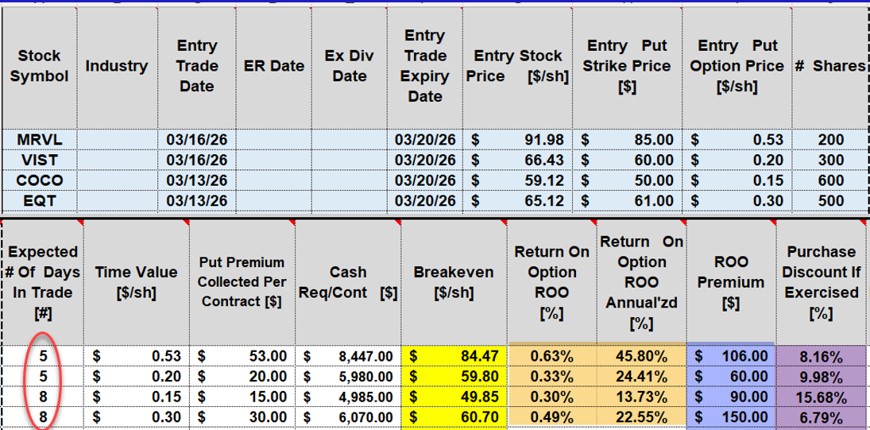
- Red circle# days in trade
- Yellow cell: Breakeven price is $58.75
- Brown cells: Initial 5-8 day & annualized returns
- Blue cell: $ amount of premium collected
- Purple cell: % discount on initial price, if exercised
Initial Portfolio Total Returns
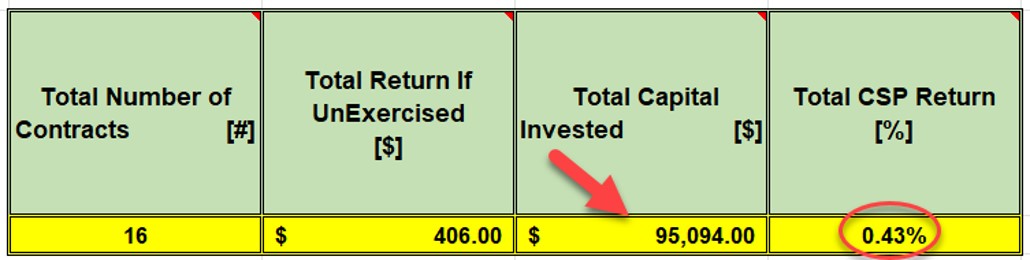
- 22.36% annualized
- $4906.00 cash reserve for exit strategies
Trade Status as of 3/20/2026 After 4 PM ET: All strikes expire OTM and worthless
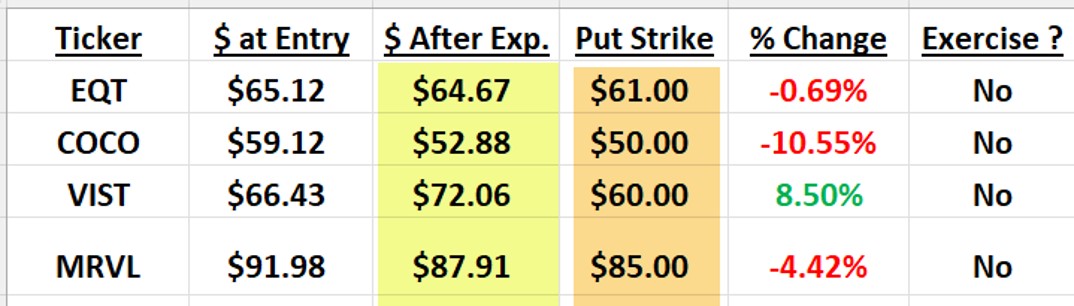
All strikes expired out-of-the-money and worthless. There was no exercise and the initial return of 22% annualized was realized.
Discussion
Our covered call writing and cash-secured put trades can generate significant annualized returns, while still offering substantial protection to the downside. This article analyzed a 4-stock, $100k portfolio which resulted in a 22% annualized return during a volatile and down-market (down > 5% year-to-date) environment.
Stock Investing for Students
A Plan to Get Rich Slowly and Retire Young
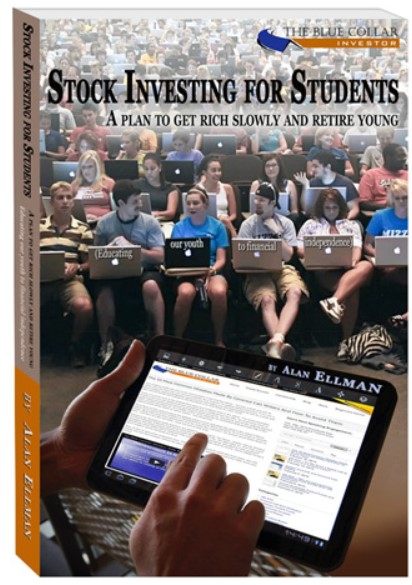
Self-investing starting at a young age can ensure a successful financial future and an early and comfortable retirement. So why is nobody doing this? The answer includes such factors as the social pressures facing our youth, certain pre-conceived ideas regarding our ability to successfully self-invest and the education or lack thereof needed to motivate our youth to undertake such a long-term project. The purpose of this book is to change that way of thinking and create a goal and a user-friendly methodology that will facilitate a plan which will allow you to retire financially securely at a relatively young age.
Free training resources
Your generous testimonials
Over the years, the BCI community has been incredibly gracious by sending our BCI team email testimonials sharing stories as to what our educational content has meant to their families. Moving forward, we have decided to publish several of these testimonials in our blog articles. We will never use a last name unless given permission:
Alan,
1. Hollywood Florida Money Show
April 8: Trading Panel
April 9: 2-hour Master Class
3:30 – 5:30
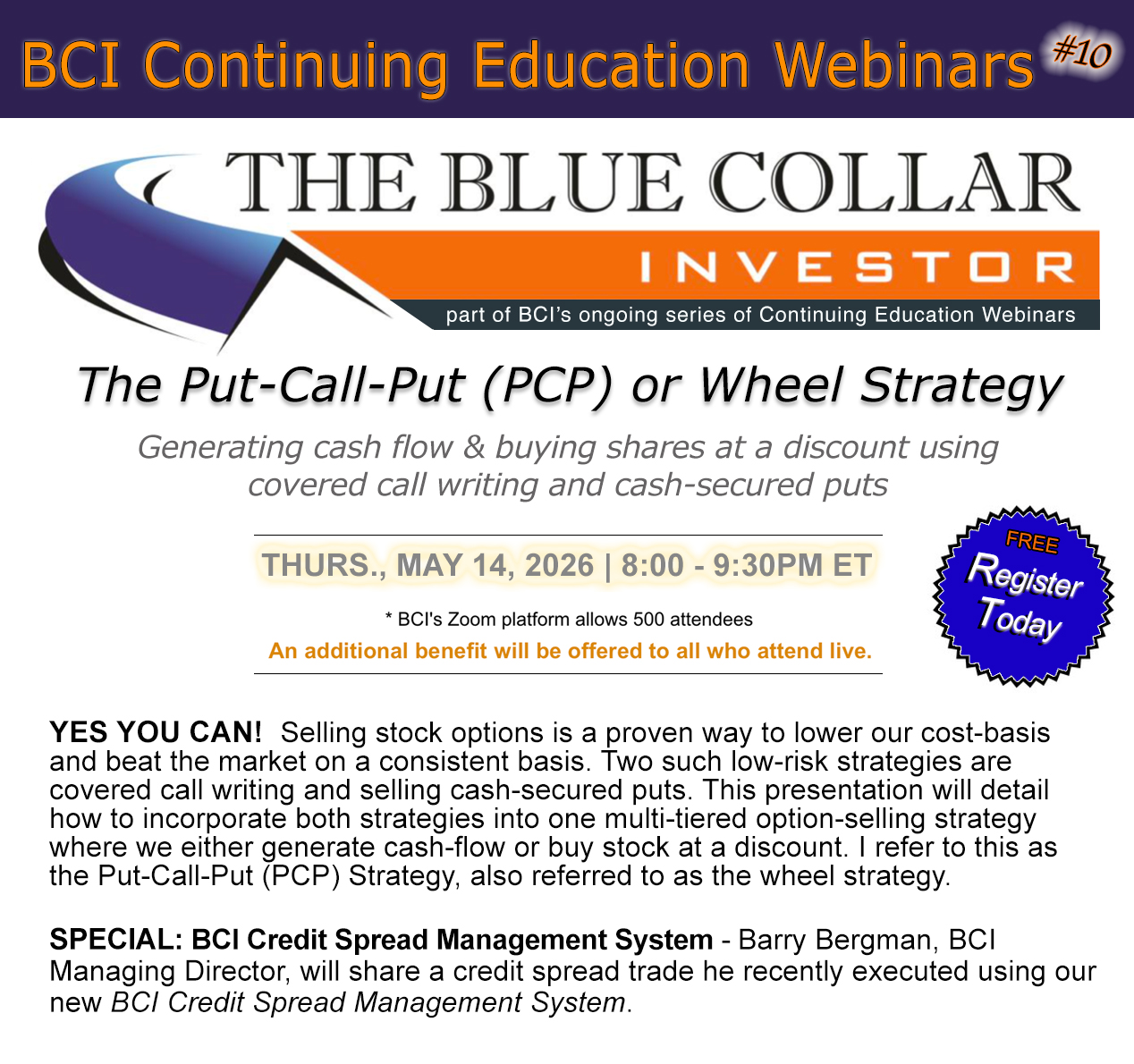
The Put-Call-Put (PCP) or Wheel Strategy
Using Both Covered Call Writing and Put-Selling to Generate Monthly Cash Flow
Selling stock options is a proven way to lower our cost-basis and beat the market on a consistent basis. Two such low-risk strategies are covered call writing and selling cash-secured puts. This presentation will detail how to incorporate both strategies into one multi-tiered option-selling strategy where we either generate cash-flow or buy shares of stock at a discount. I refer to this as the Put-Call-Put (PCP) Strategy, also referred to as the wheel strategy.
The basics and pros and cons of low-risk option-selling strategies will be discussed as well as an analysis of a real-life example and introduction into the BCI Trade Management Calculator (TMC). This seminar is appropriate for those who look to generate modest, but consistent, returns which will enable us to potentially beat the market on a consistent basis while focusing on capital preservation.
April 10: Portfolio Overwriting
11:40 – 12:25
2. Sarasota Investment Group
Portfolio Overwriting: A Form of Covered Call Writing
Wednesday April 22, 2026
Details to follow.
3. BCI Educational Webinar #10: The Put-Call-Put (PCP) or “Wheel Strategy”
Thursday May 14, 2026, at 8 PM ET
Using both covered call writing & cash-secured puts in a multi-tiered option selling strategy. A 68-day real-life example taken from one of Alan’s portfolios will be analyzed.
BONUS: Barry will share a real-life credit spread trade using our BCI Conservative Credit Spread Management System.
Discount coupons and a live Q&A session will follow the presentation.
4. American Association of Individual Investors: NYC Chapter
June 10, 2026, at 6 PM – 8 PM ET
More information to come.
5. MoneyShow Masters Symposium Las Vegas
July 20 – 22, 2026
Caesra’s Hotel
Las Vegas
Details to follow.
6. Toronto Money Show
September 24 – 25, 2026
MaRS Center, Toronto Canada
7. Orlando Money Show
October 5 – 7, 2026
Details to follow.



Premium Members,
This week’s Weekly Stock Screen and Watch List has been uploaded to The Blue Collar Investor Premium Member site and is available for download in the “Reports” section. Look for the report dated 03/27/26.
Be sure to check out the latest BCI Training Videos and “Ask Alan” segments. You can view them on The Blue Collar YouTube Channel. For your convenience, the link to the BCI YouTube Channel is:
https://www.youtube.com/user/BlueCollarInvestor
Barry and The Blue Collar Investor Team
Hi Alan,
I have just watched this impressive video.
I would like to learn more about the $100K portfolio that you are trading.
How can I follow along with you.
Kind regards,
Sean
Sean,
So pleased you enjoyed the video.
Each week, I send a sample trade, taken from one of my option portfolios, to our premium members.
We also add 4 videos each moth to our YouTube Channel, one “Ask Alan” video and 3 podcasts. Each new podcast is publicly available for 30 days and archived on our premium member site. Our premium members have access to all > 200 Ask Alan videos, with a new one added each month.
All these sample trades and videos are wonderful learning tools for our members.
Alan
Alan,
I wanted to bounce something off of you concerning lowering the cost basis (CB) of a stock that I own. The stock was PUT to me at the beginning of my Options Trading “career.” I either didn’t know about or didn’t follow your 3% guideline and now the stock price is much lower than my basis.
I was thinking about simply buying more stock at the current depressed price which would result in an instant lowering of the CB . Then placing a Covered Call with an ATM strike to finally unload this albatross. I know you have mentioned purchasing more stock as a way of lowering the CB, but wanted to make sure I wasn’t missing something obvious.
This seems like a much easier idea vs lowering the CB by slowly eating away at the CB using trades with strikes far below the CB and watching it like a hawk until exiting the trade.
Thanks Alan,
Brian
Brian,
I am, generally, NOT in favor of “averaging down” This involves adding more cash to a losing trade. Let me get philosophical …
Let’s say the stock was “put” to you at a breakeven price of $70.00 and now it’s trading at $60.00 and you have 100 shares. So, you started at a CB of $7000.00 that’s now worth $6,000.00. Your proposed strategy involves getting back, as close as possible to breakeven, by averaging down.
Now, do we care about the stock or the cash we have invested in it? That’s right, the cash. We ask ourselves, given what we know today, where is that cash best placed … in the disappointing stock or in a better performer? Correct, in a different security, unless your analysis guides you back to the same stock.
If the original stock is still an under-performer, we take our loss and move on. Not all trades will be winning ones.
If we are still bullish on the underlying security, we can write OTM covered calls and continue the cash generation process.
Bottom line: It’s usually not a good plan to add more money to a losing trade and it’s the cash, not the stock, that should be important to our trade decisions.
Alan
Thanks Alan for your advice. I appreciate your time. I agree the cash is more important vs. the stock. I was trying to brainstorm a way to break even with this stock.
Thanks again Alan,
Brian
Wonderful article (as always), Alan! Thank you for your continuing educational insights. One minor correction, VIST is actually Vista Oil & Gas; I could not find Vista Energy (you may have confused it with Vistra Energy, which is symbol VST–similar names and symbols! Reminds me of Marvell Technology and the old Marvel Entertainment back in the day, lol). Thanks again!
Mike,
So pleased you enjoyed the article.
I used the name provided by Investor’s Business Daily (IBD). I did note that CBOE.com used Vista Oil & Gas, so maybe the company has 2 names … like Superman.
Click on the link below to see VIST on IBD.
Alan
Alan,
Thanks for the wartime covered call video. My understanding of the rationale around the 20%/10% guidelines is that we accept a lower time value (i.e., positive) return, rather than attempting to let the option price run to $0, in exchange for reducing assignment risk by closing out the trade when most of the expected premium has already been realized.
However, in applying the 20%/10% BTC guidelines to deep ITM calls, are we not possibly locking in a loss or negative result instead?
Using your example, the premium is $8.05, but that is made up of $7.30 of intrinsic value and $0.75 of time value. So, if we buy back the option when its price falls to $1.60 (20% BTC) that $1.60 consists of all of the time value or upside in the transaction ($0.75) and the remaining $0.85 in intrinsic value.
So, if we’re trading 5 contracts, we lock in a $425 loss (500 shares X $0.85).
Do I have this right or is there something I’m not seeing? If my understanding is correct, are you accepting a $425 loss because it is superior to possibly incurring a larger loss later?
Where can I find the wartime strategies for cash-secured puts video that you said you recently did. At present I mostly trade puts.
Thanks,
John
John,
Ther 20%/10% guidelines for covered call writing are different then the 20%/10% guidelines for cash-secured puts. For calls, it represents a defensive strategy when share price declines. For puts, it creates an opportunity to generate higher than a maximum return when share price accelerates.
Since your question relates to my recent covered call video, let’s focus in on that.
The purpose of the 20%/10% guidelines is to protect us against catastrophic share price decline. It warns us that the price has declined significantly and we may need to take exit strategy intervention. If the threshold is reached, we now own the shares without option obligation. Yes, we may have a current loss on the option side, but opportunities to mitigate are available and the final outcome is yet to be determined.
The reason I set the 20%/10% guidelines based on the entire premium (intrinsic + time value), is because of delta. Premium will decline faster for in-the-money strikes, so we can act sooner if the trade is turning against us.
Bottom line: Buying back the option based on the 20%/10% guidelines may result in a temporary (or permanent) loss on the option side, but it puts us in a position to mitigate losing trades and avoid catastrophic losses.
Here’s the link to the wartime put video:
https://youtu.be/wMq0vC9tjhA
Alan
Got it. As I was wondering, it’s a defensive play. Thanks…and thanks for the cash-secured put video too.
John
Thanks for clarifying the symbol/name issue, Alan! I get my info from StockCharts.com and WealthCharts (it’s all about the charts for me, LOL).
At least the numbers all match. Have a wonderful week and I look forward to your next webinar!
Hi Alan,
When it comes to Covered Call Writing for the long term it is often referred to as portfolio overwriting.
When you use this strategy, do you use RSI as a measurement? Do you find it useful or not?
My thoughts on this: Why not sell only CC’s when the stock has a high RSI? Much more premium and a good chance of keeping the stocks?
Furthermore: In your research you do not use Bollinger bands. Can you explain why?
Would be great if you can share your thoughts on these things.
Thanks in advance and greetings from NL,
Bas
Bas,
For portfolio overwriting, share retention is a requirement. This makes strike selection critical.
The metrics I use for strike selection are delta and implied volatility (IV), both of which can be utilized to measure the risk of exercise without exit strategies. BCI has developed a spreadsheet which has a conversion formula which will take the ATM IV from an option chain and convert it to one specific for the contract in question, which will then deliver a trading range, which can be based on 1- or 2 standard deviations.
When we include exit strategies (buying back an ITM call prior to contract expiration), the risk of exercise becomes < 1%. Bottom line: The metrics I use for Portfolio Overwriting are delta and IV. One more important point: It is critical to avoid earnings report dates and ex-dividend dates (if this applies) to manage PO trades. Alan
Premium Members:
1. This week’s ETF Report has been uploaded to your member site. Login to the member site and scroll down on the left side to access the report.
ETF Report Video Link:
Explanation of the report format:
https://youtu.be/addf7Y54ixwput
2. I’ve attached to premium member emails a 3-contract, 4-day cash-secured put trade, using MRVL as the underlying stock. I executed these trades on 3/30/2016, for the 4/2/2026 expirations (4-days). Friday is a market-recognized (Good Friday) holiday. Significant initial returns and downside protection were generated at the onset of the trades. This is an example of the type of defensive trades I have been favoring. MRVL closed at $106.71 today, up $17.25 from the starting point. The huge 3-day share appreciation allowed me to roll-up the put strike on Tuesday from $82.00 to $90.00 and again today (Wednesday) from $90.00 to $98.00. This generated 2 more income streams into my portfolio. The current price is $8.71 above the most recent put strike with 1 trading day remaining. As always, I remain prepared to execute exit strategies, if those opportunities arise.
3. Our loyalty pledge to you: Premium members will NEVER experience a rate hike as long as premium member subscriptions remains active … NEVER.
4. Have you seen my 2nd video on Wartime Option Strategies? This one is on covered call writing:
https://youtu.be/Z0SonSFCTN4
Wishing you the best results,
Alan & the BCI team