
Latest Insights in Stock Market Investing

Timing Our Covered Call Trades: Lost Opportunity to Generate Cash with Facebook + Black Friday Discount through Monday
Our covered call options should be sold simultaneously with the purchase of our stocks. If we have evaluated a stock and have a bullish assessment for our covered call portfolio, we next check an option-chain to see if the initial time-value returns meet our goals (...

Making Money with Technology Stocks: Investing with QQQ
The exchange-traded fund (ETF) that has appeared most frequently in our premium member ETF reports is Invesco QQQ Trust (NASDAQ: QQQ). This fund consists of 100 of the largest non-financial companies (predominantly technology companies) that trade on the NASDAQ...

In-The-Money Cash-Secured Puts: Allow Exercise or Roll the Option When Using the PCP Strategy?
As contract expiration nears, we must be prepared how to manage our in-the-money (ITM) cash-secured puts. Assuming we initially sold an out-of-the-money (OTM) put which is now ITM, share price has declined. We can assume that by following the BCI guidelines for...

Expiration Dates versus Expiration Times: Important Clarifications
When we sell covered call options or cash-secured puts, the expiration date of our monthly option contracts is usually the third Friday of the month at 4 PM ET. However, this is not to be confused with the expiration time of these contracts. The latter is the date and...

Selling Deep In-The-Money Calls to Exit Stock Positions
Covered call writing is used predominantly to generate cash flow in a low-risk manner. But it can also be used to exit stock positions while mitigating losses in those trades. As an example, I will use a series of trades shared with me by Ashvin on May 16th, 2019. The...

Implied Volatility and Expected Price Movement of our Stocks During the Life of a Contract
Implied volatility (IV) is directly related to the value of the premiums we receive when selling covered call and put options. The more volatile the underlying security, the greater the premium and risk exposure. I have written quite a bit about IV over the years and...

Delta as the Sole Criteria for Covered Call Writing Strike Selection
Strike selection is the second required skill when writing covered call options or selling cash-secured puts. Over the years I have been asked to suggest a specific Delta for strike selection implying that this statistic would be the sole criterion to determine strike...

Rolling Up in the Same Contract Month: A Real-Life Example with KMX
Position management or exit strategies for covered call writing and selling puts is the third required skill to achieve the highest possible return levels (stock and option selection are the first two). First, we must determine if an exit strategy opportunity actually...
Rolling Deep OTM Puts to a Higher Strike: A Viable Mid-Contract Strategy?
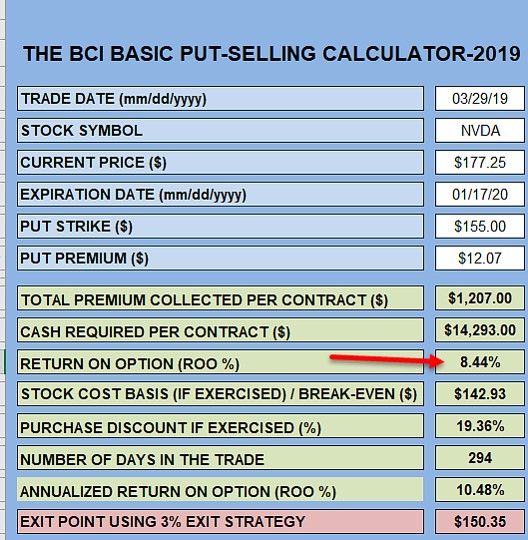
After selling an out-of-the-money (OTM) cash-secured put and then stock price accelerates substantially, the put value will decline. Share price and put value are inversely-related. This allows us to take advantage of our 20%/10% put-selling guidelines exit strategy...
 Podcast
- 126. Analyzing the Status of a Rolling-Down Trade
- 124. Dividends and After-Hours News Causing Exercise of OTM Call Strikes
- 123. Implied Volatility, IV Rank and IV Percentile Defined and Practical Applications
- BCI PODCAST 122: Should I Roll-Out My Deep In-The-Money Call Option Mid-Contract?
- BCI PODCAST 121: What is a SPAC (Special Purpose Acquisition Company)?
- 120. Using the Nasdaq-100 Volatility Index (VOLQ) in Covered Call Writing Decisions
- 119. Establishing Our Cost-Basis for Long-Term Holdings
- 118. Adjusting Our Portfolio Mix to Achieve Diversification and Cash Allocation
- 117. When a Covered Call Strike Moves $1000.00 In-The-Money
- 116. How to Execute a Covered Call Trade with a Buy/Write Combination Form
Explore Investment Topics
Covered Call Exit Strategies
Exit Strategies
Our Journey and Mission
The Blue Collar Investor was founded with a simple mission: to empower everyday individuals with the knowledge to invest wisely in the stock market. Our blog focuses on demystifying stock options, providing readers with the tools they need to succeed. We believe that anyone can learn to invest effectively, regardless of their background or experience.
Our story began when our founder Dr. Alan Ellman, realized the lack of accessible resources for average investors. Determined to bridge this gap, we created a platform that offers comprehensive guides, expert tips, and real-world strategies. Today, The Blue Collar Investor is a trusted resource for thousands of readers seeking to enhance their financial literacy and achieve their investment goals.