
Executing covered call trades begins when we instruct our online discount brokers what we want them to do for us. When instructing our online discount broker as to the actions we want taken, we submit a customer order. These orders can take several different forms depending on our investment strategies and objectives. We can buy or sell; request a specific price or simply the best available price; we can stipulate an action given a particular circumstance; and we can use combinations of orders. Let’s look at the most common of these orders and the situations when we may utilize them.
Market Order:
This is the most common of customer orders where we ask the broker to buy or sell a stock or option at the best available price. It is also called an “unrestricted order” and will always be executed.
Limit Order:
This is an order to buy or sell a specific number of shares at a certain price or better. A buy limit order can only be executed at the limit price or lower. A sell limit order must be executed at the limit price or higher. These are particularly useful on low-volume or highly volatile stocks.
Stop Order:
An order to buy or sell a security when its price surpasses a specific price called the stop price. At that point the stop order becomes a market order. A sell stop order is placed below the current market value of the stock and is used to prevent or limit a loss or to protect a profit on a long stock position. For example, you may have purchased a stock for $20 per share and it has appreciated to $30. A sell stop order @ $25 will guarantee at least a profit of $5 per share (barring a gap-down in the price of the stock). A buy stop order is always placed above the current market price of the stock. It is typically used to protect a profit or limit a loss on a short sale (selling a stock you didn’t own by borrowing it). For example, if you sell short a stock @ $30 expecting to buy it back at a lower price but it starts going up in value instead, a buy stop order can limit your loss. It may kick in @ $32 thereby minimizing losses to $2 per share. Once the buy stop price is reached, the order becomes a market order.
Stop Limit Order:
This is a combination of a stop order and a limit order. Once activated, it becomes a limit order which means that it can only be executed at a specific price or better. The benefit is that the trader has precise control over when the order should be filled. The disadvantage is that it may never get filled. A sell stop-limit order is always placed below the current market price of the equity and is used to limit the loss or protect the profit on a long stock position. Once activated, it becomes a limit order. A buy stop-limit order is always placed above the current price of the stock and is used to limit a loss or protect the profit on a short stock position. Once activated, it becomes a limit order.
Trailing stop:
A trailing stop adjusts the stop price at a fixed percent or number of points below the market price of a stock. The purpose of the stop is to protect against a move by the stock or option price in the opposite direction from which you expect. When the price of your stock rises, the trailing stop rises with it, helping to protect you against a larger loss and eventually capturing a portion of your profit. With a trailing stop, you continue to hold the stock so you still receive the dividends from the stock, if they are paid. Should the stock plunge past your stop, your shares are sold at the next available price, not necessarily the stop price, assuming you have not placed the stop order with a limit price.
Summary of Orders entered Above the Market:
- Buy Stop-Limit
- Buy Stop
- Sell Limit
Summary of Orders entered Below Market:
- Buy Limit
- Sell Stop
- Sell Stop-Limit
- Trailing stop
Covered Call Trade Orders:
As discussed in previous articles, most writers of covered calls place their trades by legging in. This where a market or limit order is placed to purchase the equity and once executed, a second order (usually limit) is placed to sell the option. For maximum profits, these two legs should be executed simultaneously (Buy the stock and immediately sell the option. Do not buy the stock, go to the mall and then come back home to sell the option). Another methodology permitted by some online discount brokers (not USAA, the one I use) is to place a net debit order. This is where you buy the stock and sell the option at the exact same time, not for specific corresponding prices but for a limit net debit. For example, if a stock is selling for $20 and the A-T-M call is selling for $1.50, the net debit or amount we would owe is $18.50 ($20 minus $1.50). This way, even if the price of the stock and option change, the order can still be filled if it meets the requirements of our debit order. This would be particularly useful for investors who can’t be in front of their computers but want to execute a covered call trade. As stock investors and covered call writers it is critical to know and understand the different types of customer orders and the appropriate time to implement them.
Covered call limit order example:
In the options chain below, ULTA is trading @ $93.55 and the bid-ask spread is $1.95 – $2.30. Placing a market order may generate $1.95 but placing a limit order slightly below the mid-point @ $2.10 has an excellent chance at being executed for an additional $15 per contract:
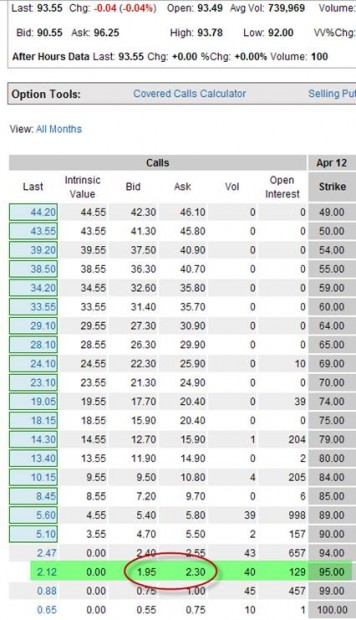
Options chain for ULTA
Market tone:
Economic reports this past week were dominated by mixed housing information:
- New home construction decreased by 1.1% in February but still near a 3-year high
- Building permit applications rose by 5.1%, the highest rate since October, 2008
- The rate of housing completions was up 6.2% from January
- Single-family home starts were up 18% from February, 2011
- New home sales dropped by 1.6% in February, the second straight monthly decline but…
- New home sales rose by 11% from February, 2011
- The Conference Board’s leading economic indicators rose by 0.7% in February, the 5th consecutive monthly gain and an 11-month high
For the week, the S&P 500 fell by 0.5% for a year-to-date return of 11.6%.
A 6-month comparison chart of the S&P 500 and the CBOE Volatility Index (VIX) shows bullish signals:
- Uptrending S&P 500 (red arrow)
- Calming VIX (green arrow)
- Consolidating signals the last two weeks, perhaps a welcome breather (yellow fields)

Market tone 3-23-12

Alan,
Do you ever use market orders for your covered call writing? Thank you.
Nancy
Nancy,
I use market orders for the stock end of the transactions most of the time when the following criteria are met:
1- Relatively small (tight) bid-ask spreads
2- Confidence in online discount broker to execute at a favorable price
3- Meets our system criteria of average daily trading volume of 250,000 shares/day
Because the stock is more liquid than the options, market orders make sense in most cases. I will only use limit orders for the options end. “Negotiating” a better price between the bid-ask spread for options will frequently put additional cash into our pockets.
Alan
Alan,
How do you manage a trade when a limit order does not get executed? Keep up your great work.
Maria
Maria,
If I placed the limit order slightly below the mid-point of the bid-ask spread and I see my offer published, I will place a new offer based on the new bid-ask spread. I will not move on to my next trade until this one is completed. It’s funny, even if I end up generating an additional $0.05 I get a feeling of satisfaction and almost want to high-five myself. Anyway, the cash is better off in our pockets than those of the market makers.
Alan
Premium Members,
The Weekly Report for 03-23-12 has been uploaded to the Premium Member website and is available for download.
Best,
Barry and The BCI Team
Last month I purchased CSTR @ 57.23 and sold the 60 call. I decided to rollout to the 60 call again last expiration Friday as the stock price went to over 61. So far my 2 month return is about 12% with options and share appreciation. The last 2 weeks CSTR is off our watch list because of technicals and the price is @ 60.80. Do I need to take any action at this time or monitor in the same way as if it was on our watch list? Thanks for any help.
Dave
Dave,
Once you are in a covered call position, it should be monitored in the same manner as a stock currently on the premium watch list. At this point the main factor would be the 20%/10% guidelines. You can also check into any recent news that may impact your decision. Here is an excellent site for that:
http://www.finviz.com/
Alan
Dave,
CSTR is up $2 to $62.93 this morning. This means that your 12%, 2-month profit is protected by $2.93. Keep monitoring but looking good.
Alan
Premium Members:
This week’s Weekly Stock Screen And Watch List has been revised and uploaded to The Blue Collar Investor premium member site and is available in the “Reports” section. The Running List section has been reformatted to improve clarity (gold highlight added) and does not impact any investment decision you have made. Look for the report dated 03-23-12-REVA.
For your convenience, here is the link to login to the premium site:
https://www.thebluecollarinvestor.com/member/login.php
Best,
Barry and the BCI Team
Alan,
I’m considering a covered call with FIRE tomorrow. The 50 call option returns > 4% with a bid-ask spread of 2 – 2.20. Would you place a limit order @ 2, 2.05, 2.10?
Thanks.
Harvey
Harvey,
In the scenario you present and based on my experience over the years I would place a limit order @ $2.05, slightly below the mid-point. If you use $2.10, the market maker may publish a new bid-ask spread @ $2 – $2.10 in which case you would have to settle for $2. When david goes up against Goliath, he must use the sling shot that gives him the best chance to win!
Alan
Great article.
suresh
Hello Alan,
I read some of your blogs and watch some of your videos on options. I am a beginner in the options game. I have been trading stocks for some time but not very successful in making profits. I am planning to take membership with your firm for advice and knowledge. do you also offer individual advice on specific questions I have regarding option trading? Thanks for your help to the community.
-Sri
Hi Sri,
Welcome to the BCI community! Our mission statement is for you to become “CEO of your own money” and ultimately financially independent. We provide the educational tools to support these goals. Placing inquiries on this blog will usually be answered by other members, members of my team or myself. We are here for each other and we all benefit. If you would like more personalized attention, consider our phone coaching program:
https://www.thebluecollarinvestor.com/investment-coach/
Take your time: Learn, paper trade and then let us know about your success stories.
Alan
What do you think?
Just bought 800 shares UBNT @ $32.39
Sold 8 x April 30s for 3.20
4-week return = 2.7% ($648 less commissions)
Protection of profit = 7.4%
Happy trading.
Fred
Fred, I saw your post yesterday and decided to go with the same trade this morning.
buy at 32.22
sell 30 call at 3.05
2.8% return
6.9% protection of profit
Thanks for sharing.
Amy
Alan,
I recently became a premium member and I’m curious as to how best to use the “beta” column of the running list. Keep up the good work.
Nick
Nick,
We welcome you as a new premium member. In the BCI methodology we use beta as a secondary filter when selecting our covered call candidates. Stocks with high betas tend to outperform in bull markets and stocks with low betas outperform in bear markets. If the S&P 500 was up 4% in a given year, a stock with a beta of 1.5 would be expected to be up 6%. A stock with a beta of 0.5 would be expected to rise by 2%. Depending on your market assessment and personal risk tolerance beta can be used to fine tune your selection process.
Alan
Premium members:
This week’s 6-page report of top-performing ETFs and analysis of ALL Select Sector Components has been uploaded to your premium site.
For your convenience, here is the link to login to the premium site:
https://www.thebluecollarinvestor.com/member/login.php
Not a premium member? Check out this link:
https://www.thebluecollarinvestor.com/membership.shtml
Alan and the BCI team
Hi Alan
I was wondering if it is possible to do the “top down analysis” using the information we get from the premium site?
My idea is that we get a report on ETF from your team around this time. I think we can use that report to see which sectors are performing best. Then on Sunday, we get the weekly stock screen. So, the methodology is to select the sectors from the first email on the best performing ETF, then select the stocks that are in that sector from the second report. Of course the BCI investor does not to have more than 20% of the portfolio in any one sector, so if I want 5 stocks, then simply select 5 sectors and select one stock from each of these sectors from the weekly stock screen.
Please give me your views on this idea. It sounds very simple but then why does it have to be complicated? Based on this thinking, is it possible for you to name 5 sectors that you would be happy to have the stocks from?
Many thanks
Suresh
Suresh,
Your idea makes a lot of sense. Selecting stocks from the best-performing industries is a BCI requirement. There is a way of accomplishing this with the premium stock report alone. On the “running list” (pages 3-6 of the report) we list the industry segment rank for each stock. What you can do is select only those equities with ranks of “A” or perhaps “A’ or “B”. See the screenshot I created below:
Keep up the good work!
Alan
That makes a lot of sense, Alan.
Many thanks
Suresh
Running list stocks in the news: ALLT:
This is a small-cap computer (bandwidth) related company based in Israel. In the past 5 earnings reports there have been POSITIVE surprises of 100%, 20%, 14%, 57% and 20%. Recently year-to-year sales growth was reported @ 36%. As a result ALLT has outperformed the S&P 500 by 37.5% over the past year. Our premium watch list shows an industry segment rank of “A” and a beta of an aggressive 1.71 (not for extremely conservative investors). Below I constructed a chart based on our BCI methodology depicting the bullish technicals (click on chart to enlarge and use the back arrow to return to this blog).
Alan
Example of using trend lines/20 day EMA…
BCI community,
Here is a good example of using the technical tools that Alan teaches…in this case, the use of the 20 day EMA.
3/27/12 – Entered trade for LULU
– BOT stock at $75.01
– STO Apr $75 call (ATM) for $2.52
– Initial return of 3.3%
Over the next two days, LULU was dropping. However, in reviewing LULU’s chart, the 20 EMA has been acting as solid support recently. When LULU was hovering at the 20 EMA, I BTC the call.
3/28/12 – Bought back April $75 call
– BTC Apr $75 call for $1.70
– Net on a one day trade of $0,82 or 1%
LULU bounced off of the 20 EMA today…back to the $75 area
3/30/12 – Re-sold the Apr $75 ATM call
– STO Apr $75 call for $2.50
– Initial return of 3.3%
Net so far in the trade is approx. 4.4% with three weeks for the trade to run.
So, a few take aways…
[1] The moving averages can act as support (per pg. 48 in Alan’s
new book)
[2] The price action took advantage of Beta…in LULU’s case, the
beta is 1.37, so it is somewhat more volatile than the market in
general (S&P 500)
[3] A few minutes spent looking at the chart and historical price
action yielded an additional 1% return in a very short time
Best,
Barry
Very well done, Barry.
This is what Alan referrers as hitting the double. I have a position on LULU as well, save that I did not see the support at 20 day EMA, so I decided to buy a long put and collar the stock.
If the trend continues up than I shall close the long put.
Regards
Suresh
Suresh,
I love collars…they have saved me on numerous occasions.
Barry