
When we sell a covered call option, we are undertaking an obligation for which we are well paid. Should the option holder decide to exercise that option, we must sell our shares at the specified strike price at or prior to the expiration date. This is the nature of American style options as opposed to European style options which can be exercised only on expiration Friday.
For the most part, share assignment will not occur until after expiration Friday when the agreed upon strike price is below the current market value. For example, if we sold the $50 strike and the current value of the stock is $52, the option holder or brokerage will exercise that option and achieve a $2 per share profit. Expect almost all options that are $0.01 or more in-the-money to be exercised.
Why aren’t most options exercised early?
Option value consists of intrinsic + time value. Early exercise will result in the holder surrendering this time value, so it rarely occurs. The option owner may sell the call to capture the time value but early exercise and purchase of our shares does not make sense if there is significant time value remaining. It’s true that the shares can be purchased and then sold at market to capture intrinsic value but why not just sell the call and benefit from both time and intrinsic value? This concept applies to I-T-M and at or near-the-money strikes as O-T-M strikes would rarely be exercised. There are some rare exceptions as described in a recent article I published:
How is it determined which shares are assigned if early assignment?
This is a completely random process whereby the Options Clearing Corporation (OCC) decides to which brokerage the assignment will be given and the brokerage will then pass it on to one of its clients.
Why does early assignment occur?
As time value declines, the chance of early assignment increases. There are times when the calls trade below the intrinsic value and in these cases the chance of early assignment is much greater. This will occur when the strike is deep I-T-M. Let’s look at the options chain for VIT, as an example:
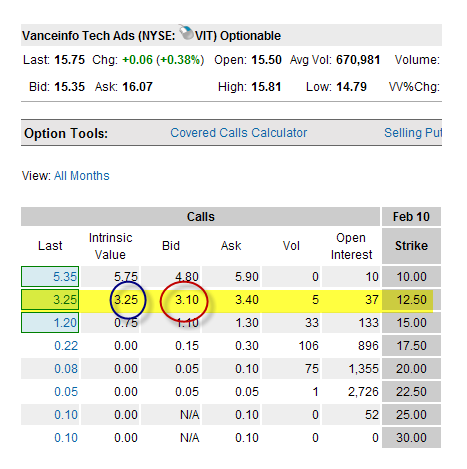
Options chain for VIT
Early Assignment Possible for $12.50 Call
Note that the intrinsic value of the $12.50 call is @ $3.25 (since the stock price is $15.75) and yet the bid or our sale price of the option is $3.10 (red circle). Not only is there no time value for this option but it is actually trading below the intrinsic value. The last sale was @ $3.25 which is actually the exact amount of intrinsic value. The $15 strike, on the other hand, has time value of $0.35 ($1.10 – $0.75). As your strike moves deeper I-T-M, the chance of early assignment increases.
Other factors that may lead to early assignment:
1- Dividends– When your equity is about to distribute a dividend, early assignment is possible for strikes when that dividend value is greater than the time value remaining for that option. This will take place prior to the ex-dividend date or the date share ownership is required to be eligible to capture this dividend. This is the most common reason for early assignment. Here is a link to a FREE site that tracks these dates:
2- High Open Interest– When you see thousands of open contracts we know that the institutional players are involved. Their trading costs are near zero and their arbitrage opportunities are greater than ours when time value approaches zero.
3- Pinning the strike– when puts and calls are near the money on expiration Friday, there is a tendency called pinning the strike for the stock to move to the strike price or slightly beyond. This may result in assignment (not early, but unexpected) after the bell. This can also take place if there is a report or late news coming out the day of expiration.
When to avoid assignment:
1- To generate more cash (mid-contract) – If there is little or no time value remaining in our option (sold), why not unwind our position? Buy-to-close the call and sell the stock thereby re-capturing the intrinsic value of the premium. Now take that bundle of cash and re-invest it in another covered call position. Remember, covered call writers are tough “bosses”. No vacations or days off for our cash. They are put to work at all times during normal market conditions.
2- To avoid tax consequences– If your cost basis is much lower than the current market value of your shares, assignment may result in an unfavorable tax consequence. In these cases, you will want to close or role your calls before assignment. If your shares are unexpectedly assigned, you can purchase new shares at market and inform your broker that these new shares are to be the ones associated with the assigned option. Please check with your tax advisor and brokerage on these matters.
Conclusion:
Early assignment of your shares is rare but possible. Understanding why and when it may occur will further add to the bottom line of your investment success.
My Guest blog for Dale Perryman’s Center for Organized Learning:
Westmoor Country Club
400 S Moorland Rd, Brookfield, WI 53005
-
The US foreign trade gap (a report of the difference between the dollar value of exports and imports. Foreign trade is an important component of aggregate economic activity, representing a significant portion of gross domestic product. Also, the level of exports is an indicator of the global competitiveness of U.S. industries) widened to $48.7 billion much higher than the $41.3 billion expected. This is the highest its been since 2008 and partially caused by the weak European economies
-
Consumer borrowing rose in November by $16 billion, higher than the $12.5 billion anticipated. Consumer credit as reported by the Federal Reserve Board is a report of the dollar value of consumer debt, including categories such as credit card use and store charge accounts (known as revolving debt) as well as longer-term loans for autos, education, recreation vehicles, etc. (known as nonrevolving debt). The level of consumer credit is considered a barometer of consumers’ financial health and an indicator of potential spending patterns.
- Initial jobless claims (a report of the number of individuals who filed for unemployment insurance for the first time the prior week. While the weekly figure indicates trends in the job market, the four-week moving average is considered a truer gauge) for the week ending January 5th was @ 371,000, more than the 365,000 expected
For the week ending on January 11th, the S&P 500 rose by 0.4% to 1,472.
Summary:
IBD: Market in a confirmed uptrend
BCI: Cautiously bullish favoring in-the-money strikes and fully invested
Wishing you the best in investing,

Alan,
Is the option always exercised early if the dividend value is greater than the option value? Thanks and keep up the good work.
Gary
Gary,
The short answer is no. Two things are pertinent here:
1- It is ONLY the time value of the premium that we look at. For example, if the stock is trading @ $30.50 and the $30 call is trading @ $0.75, the time value of the option is $0.25. If the dividend is greater than $0.25, the option MAY be exercised early.
2- Institutional investors are aware of these dividend distributions but average retail investors may not be. So even if the divdend is > time value, there may be no exercise of the options.
Alan
Premium Members,
The Weekly Report for 01-11-13 has been uploaded to the Premium Member website and is available for download.
Also, be sure to check out the latest BCI Training Videos and “Ask Alan” segments. You can view them at The Blue Collar YouTube Channel. For your convenience, the BCI YouTube Channel link is:
http://www.youtube.com/user/BlueCollarInvestor
Since we are entering Earnings Season, be sure to read Alan’s article, “Constructing Your Covered Call Portfolio During Earnings Season”. You can access it at:
https://www.thebluecollarinvestor.com/constructing-your-covered-call-portfolio-during-earnings-season/
Best,
Barry and The BCI Team
South Florida seminar:
I’m pleased to announce that I just accepted an invitation to speak at the South Florida Options Trading Meetup on Thursday March 21st from 6PM to 9PM. We are grateful to have a huge following from Florida and I’d love to personally meet as many of you as possible. Details to follow.
Alan
Special cash dividend: MAIN
Alan,
A quick question. We bought 200 shares of MAIN at $29.99 per share and sold 2 MAIN 01/19/2013 30.00 C at $0.60 per share for a modest 2% ROO. Since then the 30 strike is listed as N/A in the option chains and my brokerage portfolio now shows my option as MAIN 01/19/2013 29.65 C. Would you have any idea what might have happened? This ended up costing me a considerable amount of my ROO, especially now since the contracts are over $2.40 in the money.
Thanks again for all your help
Sincerely,
John
Hi John,
All is well in covered call land as you made a great trade. Here’s what happened:
MAIN declared a special (one time) cash dividend of $0.35 per share which means you will receive $70 in your account later this month:
http://www.cboe.com/publish/ttstocksm/12-710.pdf
This moved the stock and strike price down by $0.35.
Since you sold an at-the-money strike there was always a good chance the strike would end up in-the-money as it sits now. If you “allow” assignment (if you elect not to roll the option) your shares will be sold for $29.65 + the $0.35 dividend for a total of $30 and a neat 2%, 1-month return.
That’s 24% annualized!
Keep up the good work.
Alan
Multiple strike prices in the same month: QQQ:
There has been a bit of confusion when this occurs. Some securities have weekly as well as monthly contracts and QQQ is one such security. The way to differentiate is to look at the dates in the option ticker as shown in the screenshot below: (click on image to enlarge and use the back arrow to return to this blog):
Premium members:
This week’s 6-page report of top-performing ETFs and analysis of ALL Select Sector Components has been uploaded to your premium site. The report also lists Top-performing ETFs with Weekly options.
For your convenience, here is the link to login to the premium site:
https://www.thebluecollarinvestor.com/member/login.php
NOT A PREMIUM MEMBER? Check out this link:
https://www.thebluecollarinvestor.com/membership.shtml
Alan and the BCI team
Alan, you’ve written in the past about “pinning strikes.” AAPL’s close on Friday could become your new example. Steve
Steve,
Very interesting! Also, check out CRM…closed at 170.02!
Best,
Barry
Premium Members,
This week’s Weekly Stock Screen And Watch List has been uploaded to The Blue Collar Investor premium member site and is available for download in the “Reports” section. Look for the report dated 01-18-13.
Also, be sure to check out the latest BCI Training Videos and “Ask Alan” segments. You can view them at The Blue Collar YouTube Channel. For your convenience, the link to the BCI YouTube Channel is:
http://www.youtube.com/user/BlueCollarInvestor
Since Earnings Season is in full swing right now, be sure to read Alan’s article, “Constructing Your Covered Call Portfolio During Earnings Season”. You can access it at:
https://www.thebluecollarinvestor.com/constructing-your-covered-call-portfolio-during-earnings-season/
Best,
Barry and The BCI Team