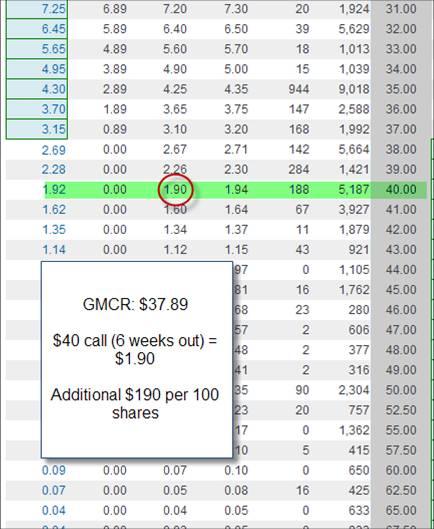
Most covered call writers purchase a stock specifically for the purpose of selling the corresponding call option. The investment time frame is one to two months as earnings reports will end the “run” of even the best performing equities (if you agree with my guidelines). In many cases share assignment is permitted by the seller and even if early assignment occurs, our investment would still have been a successful one. In other words, losing (selling) the stock is no problem and really just part of the strategy.
There are other investors who sell call options in a different manner, called portfolio overwriting. In this instance, a call option is sold on a stock already part of an existing portfolio. That option is selected in a manner where the option is NOT expected to be exercised.
Why a Portfolio Overwriter does not want his shares assigned:
This is basically a tax issue. The holding period for short-term versus long-term capital gains is one year. If the stock has been held for less than that time frame, the writer would prefer to retain the equity for a longer time frame. In addition, if the shares have appreciated substantially from the cost basis, selling in any time frame may not be in the investors best interest.
Another important tax issue:
If the underlying stock has not accumulated the full 1-year holding period for long-term capital gains, covered call writing may suspend or eliminate the current accumulated holding period. It is advisable to consult with your tax advisor on this matter.
Advantages of portfolio overwriting:
- Achieve higher returns in declining, neutral and slightly bullish markets.
- Beat the returns of long-term holders of equities
- Increase portfolio downside protection, thereby minimizing risk
- Generate a monthly cash flow
- Use option profits to compound your money
Strike selection for portfolio overwriting:
Since our goals are to generate a monthly cash flow and NOT have our shares assigned, common sense dictates that we sell O-T-M strikes. This will benefit us in that time decay is greatest for these strikes and option value will dissipate as we get closer to expiration Friday. Remember, we don’t want our option strike price ending up I-T-M. Our mindset needs to be slightly different when selling these O-T-M strikes in that a 2-4%, 1-month return is too lofty a goal. I would set it more at 1-1 1/2% per month, ensuring that the implied volatility of the option is not too high. A high IV means that the market is anticipating a large price movement and that increases the possibility of the option ending up I-T-M. So settle for a lower premium and therefore less chance of assignment. As a guideline, I like to see the share price at least 5% lower than the strike sold. As an example, if I sold a $50 strike, I would want that equity to be currently trading @ $47.50 or less, with the option premium generating 1 to 1 1/2% for the month.
Why some portfolio overwriters sell I-T-M strikes:
This is a riskier strategy if keeping the stock is important to the investor but there is a case that can be made for it. It is generally used when the stock or market in general is declining and the I-T-M strikes will generate greater returns with more protection. Also, the higher delta of the option (amount the option changes with a corresponding $1 change in the stock price) will make it easier to close or roll the position (buy back the option). Investors also use the I-T-M approach in conjunction with technical analysis where support and resistance points are identified and I-T-M strikes are sold at resistance and closed or rolled if still I-T-M near expiration Friday.
What if early assignment occurs?
This will not occur often but it will eventually happen. In these cases, purchase an amount of shares equal to the obligation to deliver and notify your broker that these newly acquired shares should be indentified as the shares delivered to meet the option obligation. Check with your broker, before the fact, as to the best way to manage such scenarios.
Conclusion:
Portfolio overwriting provides many of the advantages of the buy-write strategy but because of tax implications, income goals and strike management differ and need to be fully understood before taking action.
PRGO vs. S&P 500:
A few weeks ago I highlighted PRGO for its strong fundamentals and analyst recommendations. Dave commented that the stock seemed to be outperforming the market which was heading south at the time. One way to visualize a stocks performance as it relates to overall market tone is to overlay one chart on the other. Let’s examine such a chart:
- Red arrow- PRGO is under-performing the market
- Blue arrow- The stock and index are consolidating and performing equally
- Green arrow- PRGO breaks out and starts diverging from the index and is now headed for the moon.
An uptrending price chart is particularly impressive when it is doing so despite an overall negative market tone.
Last Week’s Economic News:
A very impressive week overall on this front:
- The Fed “tightened” interest rate policy with a symbolic hike in interest rates it charges banks for emergency loans
- The minutes from the last FOMC meeting reflected confidence that the U.S. economy was in the middle of a moderate expansion and a low inflationary environment
- The CPI was up a mere 0.2%, relaxing fears of inflation
- New home construction was up 2.8% in January
- Industrial production was up 0.9% in January, showing an improving manufacturing sector
- For the week, the S&P 500 rose 3.1% for a year-to-date return of -0.3%
Next Week’s Economic Reports:
- Tuesday: Consumer confidence
- Wednesday: New-home sales
- Thursday: Durable goods
- Friday: Existing home sales and 4th quarter GDP growth.
Video now playing on the homepage:
Why Don’t More Investors Write Covered Calls?:
Wishing you much success,


46 responses so far ↓
1 admin // Feb 20, 2010 at 11:34 am
IBD Error:
For those who missed my previous post earlier today, IBD inadvertently omitted the identifying “o” for stocks with options in this weeks IBD 100 list. You can access information as to whether a stock has options from the IBD web site as follows:
1- Go to the IBD Homepage
2- Click on “Stock Research”
3- Go to Options Center
4- Scroll down to “Stock Lists”
5- Click on “All options sorted by symbol”
Here is the direct link:
http://www.investors.com/StockResearch/OptionsCenter/reports/allstocks.aspx?reportType=2
Alan
2 admin // Feb 20, 2010 at 11:40 am
Don B // Feb 20, 2010 at 11:34 am
Alan -
Just finished watching your “Why don’t more..” video. Very well done. A comment: I actually wrote my first option perhaps 30 years ago. Using the brokerage, he has to tell you all the details. You said this nicely, but that procedure is also clumsy. What burns me about myself, is that it took me until about 18 months ago to start again, using the internet of course. Now I am doing options continually.
I think that the online element may very well bring more into the fold. It is older guys like me that are coming around slowly, I bet. I know that I uncover, in general, ways to use the computer much more slowly than the younger ones do.
Just FWIW.
Don B
3 admin // Feb 20, 2010 at 12:09 pm
Don,
Based on your previous posts and obvious high level of motivation, you need to give yourself a LOT more credit! Too many gave up on CCs (and other strategies) and NEVER came back.
Great to have you part of the BCI community.
Alan
4 Dave D // Feb 20, 2010 at 10:23 pm
Hi Alan…
Although the S&P is uptrending and the VIX has “calmed down”, I am not certain how to approach this months contract period…
Ideally I like to be conservatve and go ITM… But, I also pay respect to IBD’s market outlook which currently states that “market in correction”. Therefor, I am deciding whether to go ITM or DITM (Deep In The Money)…
An example of DITM is RVBD, currently trading at 27.27. If I sold the 25 Call, I would have a ROO of 1.5% and a DP of 8.5%… I know this is VERY conservative.
What are your views on this (DITM approach)Alan?
Thankyou
Dave D
p.s. Hopefully this month CC profits can pay for all the diapers…
5 Don B // Feb 21, 2010 at 9:48 am
Dave D brot up an excellent point. So far I have not bot the IBD, therefore never know their market outlook, which I do not think shows up on the free part of the website. I held back partly because of waiting to see if this will show up on Alan’s Premium service. Alan, your comment will be sincerely appreciated.
My problem with even the Monday only special is our habit of traveling extensively every summer, so info via the web will be wonderful.
Dave, ITM, DITM, or OTM – we are all hoping you make enuf for college, never mind the didies! (g)
Don B
6 admin // Feb 21, 2010 at 12:20 pm
Dave,
Your question highlights the very reason why each investor has to make his own decisions or as I like to say: “Become CEO of Your Own Money”.
Your point is a great one: You found a stock that you like and now, based on market tone, will select the best strike. Most (less educated) CC writers will automatically go to the nearest O-T-M strike ($30). Congratulations on recognizing that that may not be your best choice.
We can all agree that the chart pattern is fabulous but the IBD statement that the market is in a correction concerns you, as it should. I am slightly more bullish on the overall market based on the very economic reports that I publish in my weekly blogs. Here are a few comments:
1- IF the market was trending up and bullish, this is a classic O-T-M sale that could generate 8-15% in one month.
2- A conservative investor will sell the deep I-T-M strike, settle for 1 1/2% (that’s 18% annualized folks) and promise not to cry if the stock continues to head for the moon.
3- Here’s what I would do if I had let’s say 5 contracts: sell 3, I-T-M and 2 O-T-M.
Bottom line: Deep I-T-M strikes are definitely in play based on chart pattern, overall market conditions and investor risk-tolerance.
Alan
7 admin // Feb 21, 2010 at 12:32 pm
Don,
Information on market outlook CAN be accessed from the IBD web site as follows:
Go to their homepage: http://www.investors.com
On the top right, go to The Big Picture
On the next page, look to the left column, “Market Pulse” in a rectangular box
In this box check for “current outlook”
I have had several requests to include market outlook (it would be my own version) on the premium site and my team and I are giving this serious consideration. We are currently working feverishly to launch this site by next week (we hope!). Once launched we will be looking to enhance this site even more. The backbone of the premium membership is the weekly screen and watch list and I hope you’ll agree with me that there is nothing like this, ANYWHERE, for covered call writing.
Alan
8 Don B // Feb 21, 2010 at 2:06 pm
Alan,
I tried carefully to follow your instructions, step by steps. Plainly, those links are not present. SO, I typed The Big Picture in and searched the site. No luck. Typed Market Pulse and searched the site. No luck. Same with Current Outlook. Also, reading some blogs there indicates that others have had the same experience, and one even stated that IBD had removed those. I add, perhaps only for paid subscribers???
Then I stumbled across IBD Market Wrap, listed by date. Great video – and she indicated “market in correction” too, which may just have solved the matter of this info.
TIA.
Don B.
9 admin // Feb 21, 2010 at 2:34 pm
Don,
Perhaps because I have been a subscriber for years, all my computers and accounts are recognized because I get this information even on Linda’s accounts. It looks like this IS a membership perk.
Alan
10 admin // Feb 22, 2010 at 12:37 pm
Stocks on the Move:
This list appears on the homepage of the IBD web site. It lists stocks up in value AND in trading volume. This represents institutional support in most cases. When I see a stock on my watch list that is on this list as well, I will give it extra consideration for my portfolio. Two such stocks from todays list are SIRO and EZPW.
Alan
11 Barry Bergman // Feb 22, 2010 at 1:24 pm
Alan,
SIRO and EZPW have been two stocks that have been on my watch list for the past few weeks.
Barry
12 Amy // Feb 22, 2010 at 1:38 pm
To our group,
While we’re mentioning some of our favorites, how about FFIV. After a dip since the last earnings report, it is back above the moving average. I’ve been making good money selling options on this stock for months.
Good luck to one and all.
Amy
13 jerry fisher // Feb 22, 2010 at 1:47 pm
Alan, Could you tell me about your new Premium website. First I have heard of it. Thank you and keep up the good work. Jerry
14 James // Feb 22, 2010 at 3:46 pm
Alan,
I read and am re-reading CCC. Great information and the website/blog supplements it very well.
I am very much a “cart before the horse” person and so I appreciate the advice to use QQQQ with smaller portfolios while paper trading the system.
I currently have 100 shares of QQQQ @ 44.60 and sold 1 March at .71.
My question is what to do with my other IRA. I have almost 20k in {deap breath} mutual funds. At what point do you move from Broad index ETF’s to individual stocks. In order to get the required 5 industries I would need stocks trading at less then $40/sh. In looking at the option chains on a lot of them they seem to be “thinly” traded. Most of the ones mentioned on this site are in the $40+ price range. Should I “play” the QQQQs until I can afford higher priced stocks?
15 admin // Feb 22, 2010 at 5:33 pm
Jerry,
I am hoping to launch the premium site this weekend or next. The foundation and main (but not only) benefit premium members will receive is the weekly stock screen and watch list. This is a UNIQUE screen based on the BCI system with parameters specific for covered call candidates. You will have an opportunity to view a video I produced that will describe all the features of this weekly report.
All those on my mailing list will be notified as soon as the site is launched. It will also be posted on the general site.
Alan
16 admin // Feb 22, 2010 at 5:45 pm
James,
You are right on target. Gingerly putting your toes in the water with one contract of the Qs while paper-trading individual equities is a sensible way to start.
Create a “fake” portfolio of 50k. Select 5 stocks in 5 different industries or 5 different sectors. Then devote approximately 10k to each stock. Divide the current price into 10k and round off to the nearest hundredths. Sell options accordingly and manage.
While you build up more cash in your accounts, you are learning and mastering the system. Make sure you do this first and then you’ll have years and decades to benefit from this great strategy.
Feel free to post any questions, problems or suggestions on this site. There are a lot of really smart and savvy investors who visit and are willing to assist. We also look forward to your success stories and advice you may have for our BCI community.
Alan
17 James // Feb 22, 2010 at 8:51 pm
Thanks Alan. I appreciate the response. I want to let the community know that I found an excellent paper trading application at the cboe if you are looking for one. It starts you out with $50k.
Do a google search for paper trading options and it will be up at the top.
18 admin // Feb 23, 2010 at 11:26 am
Thanks to James and Saul:
To James for sharing information on CBOE’s paper-trading site.
To Saul for pointing out that ER information can be accessed directly from the IBD web site as follows:
Stock Quote Page–> Stock Research –> Stock Checkup –> Type in ticker –> Scroll down to “Fundamentals” and look for “EPS Due Date”
The one piece of additional information not found here, but located at the http://www.earningswhispers.com site is whether that date has been confirmed by the company.
Thanks for sharing.
Alan
19 admin // Feb 23, 2010 at 11:29 am
VRX:
Has been one of the best performers over the past month. It reported earnings before the bell today and is down about 2% at the time of this post. I plan to re-check fundamentals and technicals by the end of this week to see if this stock remains a candidate for the March contracts.
Alan
20 Dave D // Feb 23, 2010 at 7:21 pm
BRLI
This stock shows all green smart select ratings whilst rating a 7 on MSN… Technically it looks very good indeed… IBD ‘talked it up’ in their daily market wrap video today…
BUT, its due to report earnings on the 1st of march, so we will watch its performance from their… Looks good though…
Dave D
21 admin // Feb 23, 2010 at 10:54 pm
BRLI:
Looks great in every way but one. Its average daily trading volume is 91k. Stocks with low trading volumes can easily be manipulated by shareholders or management and represent risk which we may not want to take. If not for that, I would have added this one to my watch list.
Trading volume info can be obtained from the quote page by hitting the arrow going east in the middle of the page (under “profit margin”) and looking for “average 50-d trading volume” on the next page.
Alan
22 Don B // Feb 23, 2010 at 11:03 pm
Alan –
Since I am finding it impossible to get to the info you wrote about in post #18 & #21, on the IBD site, since I have not paid for it, may I assume that this data would be covered in the new Premium service? Thank you kindly.
23 admin // Feb 24, 2010 at 2:02 am
Don,
Yes. One of the screens that you will access, is whether the stock has met our system requirement of trading at least 250,000 shares per day.
Alan
24 Rob K // Feb 24, 2010 at 9:52 am
Hello,
Just sold 2 contracts on ATHR with an ITM strike of 34 (bought the stock at 35.34). This gained me 2.2% and more importantly for me these days, 3.9% downside protection!
The stochastic lines are crossed slightly today while macd and everything look decent; you may want to examine this stock for its potential.
25 Rob K // Feb 24, 2010 at 9:53 am
I should mention that I made this buy write yesterday….ATHR is up in price today.
26 James // Feb 24, 2010 at 10:51 am
A suggestion for those that are waiting for the premium site.
)
IBD has a free 4 week trial of the site. If you want to see what everyone is looking at and get a better knack for what is going on there I recommend this.
Also, the month price is $28/m if you don’t want to invest in the yearly price while waiting for the BCI Premium service.
The trial does require a CC so put a reminder on your calendar to cancel if you aren’t planning on keeping it longer term. (no, I don’t work for IBD
27 Beth // Feb 24, 2010 at 11:17 am
Alan,
After reading your article on portfolio overwriting I’m wondering why more financial advisors aren’t using it for their clients. Any ideas?
Thanks.
Beth
28 admin // Feb 24, 2010 at 1:15 pm
Beth,
Although there are many outstanding financial advisors, most do not use covered call writing in their client’s portfolios. The reasons, in my view, fall into two categories:
1- It is not time efficient for advisors to monitor these positions, especially for 1-month options, the most lucrative time frame.
2- Some are simply not experienced in this strategy and stay with what they are most familiar with.
However, I have had emails from some advisors telling me that they will send their clients a check, generated from selling calls, from time to time with a note telling them to take a nice vacation.
For most of us, to take advantage of this wonderful strategy, we need to educate ourselves and become “CEO of our own money”.
Alan
29 Dave D // Feb 24, 2010 at 3:14 pm
Alan,
Whilst the market today seemed nuetral to bullish, and most stocks on my watchlist went up in price, I did notice one stock I own drop in price… WDC dropped 1.85 with massive volume which says some of the institutional investors may be headed for the exit…
On the other hand, I do notice that its hitting support at the EMA 100 which it has done 3 times previouslyin recent weeks…
Q: Where can one find reliable news on stocks to find out ‘why’ things like this might happen?
Q: Whats your perspective of this chart (wdc)?
Thanks Alan
30 admin // Feb 24, 2010 at 7:13 pm
Dave,
A good site for corporate news is:
http://www.reuters.com
(Your brokerage should also provide that service.)
Type in ticker and search for news articles.
When a strong stock takes a quick dive like this one, checking the news is an intelligent first step. Let me respond in a general way how I proceed in situations similar to this one:
1- Since this is early in the contract period, I am thinking opportunity rather than damage control. Chances are you can buy back the option cheaply.
2- IF the news doesn’t dictate a quick exit, I will wait a few days to a week and look to hit a double unless the stock remains in freefall.
3- If the stock does not go up in value, I will roll down or sell the stock depending on technicals and calculations. If I can sell the stock and generate cash in another position, I will take that road. If not, roll down to protect against further loss.
Alan
31 Dave D // Feb 24, 2010 at 7:19 pm
CREE:
Check this stock out…
All Green Smart Select Ratings…
Perfect 10 on MSN…
Very Good Chart Pattern… Very Bullish…
Currently, the stock is at $65.75… If one sold the March 65 Call that would be a reurn of 3.4%… Not bad… Also, there is a small downside protection of 1.1%…
For those seriously conservative investors, if one sold the March 60 Call, they would recieve a small 1%, with a huge 8.7% downside protection…
Obviously these calculations will vary as soon as the market opens again…
Dave D
32 admin // Feb 25, 2010 at 5:29 am
Dave and all,
When looking at the chart pattern for CREE, we see that the 20-d ema has been serving as reliable support for the good part of a year. Should the share price drop to this level early in the contract cycle, it may present a “hitting a double” opportunity.
Thanks to Dave for sharing.
Alan
33 Saul Seinberg // Feb 25, 2010 at 9:45 am
The chart above comparing PRGO to the S&P 500 was interesting. However, it’s often difficult to see true relative strength between two items when the charts are separate and have different growth rates.
StockCharts has a cool facility named the Ratio Chart that produces one chart from twoitems, showing when the first is performing better (black) than the second item and when it’s not (red).
Here is a link to a ratio chart that compares PRGO to the S&P 500 ($SPX); see http://tinyurl.com/y9chp2b. I’ve taken out the indicators I usually use and made a simple line chart for clarity. As you can see, PRGO has done better over the chart period than the S&P 500 and I think that’s easier to see.
If you’re looking to write a call and are down to two stocks, but can’t decide which one to write, put the stocks in a ratio chart and see which one has been performing better over the last few months. In my use of technicals, I find that relative strength is a generally reliable metric and that’s the way I often go.
If you want to do a few ratio charts of your own, simply type in the symbols for your two items, don’t forget the colon, study the resulting ratio chart and enjoy.
I hope some of you find this useful. (Sorry for the long post)
Saul…
34 Barry Bergman // Feb 25, 2010 at 11:24 am
Saul and BCI Community,
Another approach is to use the “PerfChart” on the stockcharts.com site. With this chart, you can plot the relative performance of both secutities on one chart…showing how they have (relatively) performed as a percentage of the movement from the beginning of the charted period. It is another way to look at the same information. Yyou can chart up to 10 different stocks, ETFs, etc. on the same chart. This is a very good way to help you select between different ETFs.
Barry
35 admin // Feb 25, 2010 at 12:30 pm
Thanks to Saul and Barry for sharing this valuable information. Let me share the link I used to create the chart in this article:
http://moneycentral.msn.com/investor/charts/chartdl.aspx?PT=3&compsyms=&CB=1&D4=1&D5=0&DCS=2&MA0=8192&MA1=2048&CP=1&C5=1&C5D=1&C6=1982&C7=1&C7D=1&C8=1983&C9=0&CF=0&D7=&D6=&showchartbt=Redraw+chart&symbol=%24INX&nocookie=1&SZ=0
Alan
36 Sam T // Feb 25, 2010 at 1:24 pm
Saul,
I am interested in your analysis and use of a ratio chart. Some of the discussion may not be pertinent to this blog.
If you are willing and so inclined, please email me at sam.titone@yahoo.com.
Thanks,
Sam
37 Dave D // Feb 26, 2010 at 10:03 am
ANR:
Deep In The Money
This stock passed the screening test with pretty good results, both technically and fundementally…
As the market (according to IBD) is in a correction I thought it may be suitable to go for deep in the money trades… ANR presents us with this opprtunity while still managing to get respectable returns…
Here are the current returns of the ANR March CALLS… (NOTE: At the time of this writing ANR trading at $45.53)
March 42 Call… ROO (Return on option) 1.6%… DP (Downside Protection) 7.8%
March 43 Call… ROO 2.0%… DP 5.6%
March 44 Call… ROO 2.9%… DP 3.4%
March 45 Call… ROO 3.7%… DP 1.2%
Keep in mind that there is ONLY 21 days left till expiration…
All the Best…
Dave D
If
38 admin // Feb 26, 2010 at 6:28 pm
Dave,
Excellent find! The reason that the returns are so impressive with this stock is related to its historical volatiltiy. It has a “beta” of nearly 2 which means that it is expected to double the returns or losses of the S&P 500.
Stocks with a high beta are best chosen in uptrending markets. This exemplifies why I will include beta statistics in the weekly reports when the premium site is launched next week.
Alan
39 Dave D // Feb 26, 2010 at 7:08 pm
Well I guess you learn something new every day… I just read your article on BETA… Great article and it makes lots of sense…
Wow, the BETA on ANR is pretty high… Yes, this is risky, but I guess selecting a DITM strike (which I personally did) like 42 may act to minimise some this risk…
Thanks for the information Alan…
Dave
40 Don B // Feb 26, 2010 at 8:39 pm
Alan & Dave,
On post # 37, 38, and 39 – WOW. You may recall that I mentioned swearing off ETFs that are Ultra in either direction. Couple this with beta, and what do you have? Powerful risk! For example, if an S&P stock is meant to perform double inverse, and it has a beta of 2, and the market rises one percent, how would one calculate that? (Understand that I would not touch it of course!) FWIW.
Don B
41 admin // Feb 27, 2010 at 1:34 am
Dave,
A high beta stock is not necessarily one to avoid but we should be aware of its historical performance. This will help guide us in strike selection. In a market that you more confidence in, you would have looked at an O-T-M strike to take advantage of the upside. In a down market you may have opted for a lower-beta stock. In this volatile market, you chose a great-performer and hedged with a deep I-T-M strike. Great job!
Alan
42 admin // Feb 27, 2010 at 1:37 am
Don,
If a security performs in the oposite direction as the S&P 500 or the market, it is said to have a negative beta, a -2 in your scenario. If the market rises 1%, that security is expected to decline 2%. Check out the article that Dave alluded to:
http://www.thebluecollarinvestor.com/blog/beta-another-tool-to-enhance-our-returns/
Alan
43 admin // Feb 27, 2010 at 8:59 am
Do LEAPS (long-term options) have a place in our world of covered call writing? Don’t miss my next journal article which discusses this topic.
Alan
44 Don B // Feb 27, 2010 at 9:35 am
Alan,
Re post #42, consider DXD. It was built for double inverse. If DJ rises one percent, it dutifully drops by two percent. So I guess what I am asking is, if it also has a beta of 2, doesn’t that make for a potential 4% drop? Again, FWIW. Thank you.
Don B
45 admin // Feb 27, 2010 at 11:13 am
Don,
Think of beta as the tendency of a security to fluctuate to changes in the market. For example, if the market goes up 5%, how will that security respond? If the ETF had a beta of (-) 2, that security would be expected to go down 10%.
It doessn’t matter what the brochure or goals of the ETF states. It what has actually transpired. In the case of DXD a beta of -2 would make sense since their objective is to achieve the double inverse of the market. Had the market been up 1% and DXD was down 4%, it would have a beta of (-) 4.
Beta does not guarantee a stock to behave in the manner stated, but it lets us know how it has behaved in the past relative to the overall market…in my view valuable information
Alan
46 joy // Apr 17, 2010 at 7:07 am
This stock passed the screening test with pretty good results, both technically and fundementally…
Thanks for the information
Leave a Comment