
Latest Insights in Stock Market Investing
Why Some In-The-Money Strikes Are NOT Exercised; A Real Life Example
When studying the basics of option investing we learn that the option holder of an in-the-money strike has a certain amount of intrinsic value which appears to be profit that would never be bypassed. For example, if we (as covered call writers) sold a $50 call and the...
What Is Slippage And How Does It Impact Our Trading Success?
When studying investment basics, the term slippage has two applications. In general, it means having a trade executed at a price less favorable to the trader. Let’s look at the two areas where we may see this term used: An order is executed at a worse-than-expected...
How Will the Dividend Tax Increase Affect Covered Call Writers? By Guest Author Laurie Itkin
There has been a lot of hysteria and hyperbole surrounding the expiration of the Bush-era tax cuts and how it might affect dividend income. The Blue Collar Investor’s weekly list of covered call candidates often includes a number of dividend-paying stocks as shown in...

Technical Analysis: Bar Charts vs. Candlestick Charts
Technical analysis is a key component to our stock selection process as well as our buy-sell decisions. One of the first choices we need to make is the format of the price chart. Sometimes that decision is difficult if presented with several outstanding options. For...
Portfolio Overwriting- Selling Covered Calls on Stocks You Want to Keep.
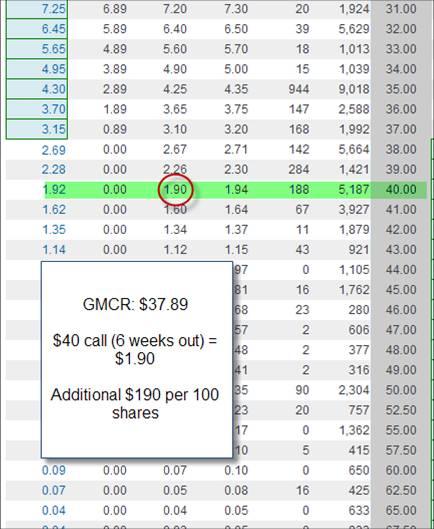
For covered call writers the main stock option strategy is to purchase an equity specifically for the purpose of selling the corresponding call option. The investment time frame is one to two months as earnings reports will end the “run” of even the best performing...
Covered Call Writing and Exchange-Traded Funds
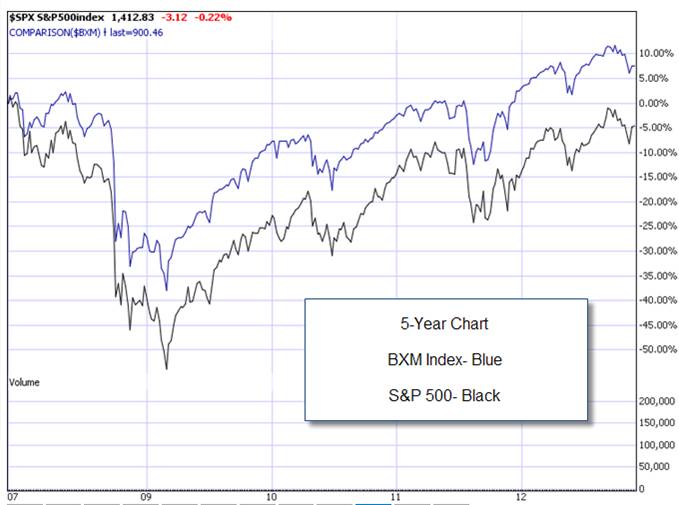
A critical requirement of my covered call writing system is to be properly diversified by stock, industry and cash allocation. No one stock or industry should represent more than 20% of your portfolio holdings. Owning five different stocks in five different industries...

S&P Futures and Fair Value.
Many covered call writers start their day by tuning in to CNBC. They look to the lower right side of the TV screen and see: The S&P Futures are UP 5 points…..GREAT!!!!!!!!!! Fair Value is + 10…….what’s that mean? The market is expected to open DOWN…….ughhhh……why?...
Executing Covered Call Trades: The Buy-Write Combination Form.
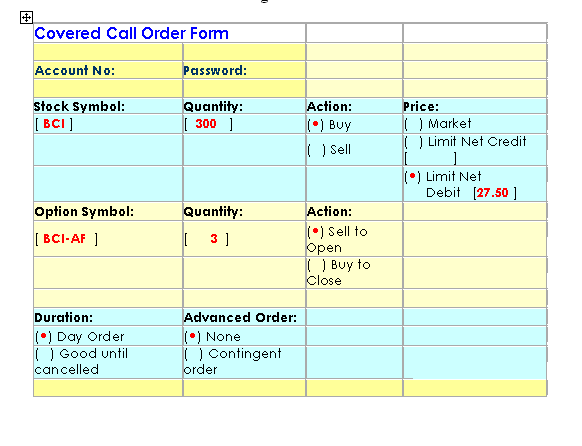
There are two ways to enter a covered call position. The first is called legging-in where the stock is purchased and then the option is sold. Two distinct trades are executed. The second is known as a buy-write order where the security purchase and option sale is...

Factors that Influence Option Value + The Black-Scholes Model
An integral part of understanding option trading basics, is mastering the components that influence option value. Many option traders will look to make money as a result of a discrepancy between an option’s current market value and its theoretical value. In other...
 Podcast
- 126. Analyzing the Status of a Rolling-Down Trade
- 124. Dividends and After-Hours News Causing Exercise of OTM Call Strikes
- 123. Implied Volatility, IV Rank and IV Percentile Defined and Practical Applications
- BCI PODCAST 122: Should I Roll-Out My Deep In-The-Money Call Option Mid-Contract?
- BCI PODCAST 121: What is a SPAC (Special Purpose Acquisition Company)?
- 120. Using the Nasdaq-100 Volatility Index (VOLQ) in Covered Call Writing Decisions
- 119. Establishing Our Cost-Basis for Long-Term Holdings
- 118. Adjusting Our Portfolio Mix to Achieve Diversification and Cash Allocation
- 117. When a Covered Call Strike Moves $1000.00 In-The-Money
- 116. How to Execute a Covered Call Trade with a Buy/Write Combination Form
Explore Investment Topics
Covered Call Exit Strategies
Exit Strategies
Our Journey and Mission
The Blue Collar Investor was founded with a simple mission: to empower everyday individuals with the knowledge to invest wisely in the stock market. Our blog focuses on demystifying stock options, providing readers with the tools they need to succeed. We believe that anyone can learn to invest effectively, regardless of their background or experience.
Our story began when our founder Dr. Alan Ellman, realized the lack of accessible resources for average investors. Determined to bridge this gap, we created a platform that offers comprehensive guides, expert tips, and real-world strategies. Today, The Blue Collar Investor is a trusted resource for thousands of readers seeking to enhance their financial literacy and achieve their investment goals.