

Option trading and covered call writing, in particular, have become increasingly popular over the past several years. As our membership has been growing more than ever, we have a large number of Blue Collar Investors who are relatively new to the process. This article will analyze a real-life covered call trade example with The Cheesecake Factory (Nasdaq: CAKE), taken from one of my portfolios
Select a stock or ETF from our watch list
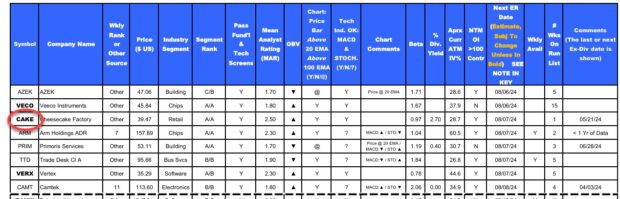
- On 6/18/2024, CAKE was an eligible security on our premium Weekly Stock Screen and Watch List
- Based on the current price-per-share, I will purchase 300 shares and sell 3 covered call contracts
Go to broker platform (Schwab, in this case) to purchase the shares
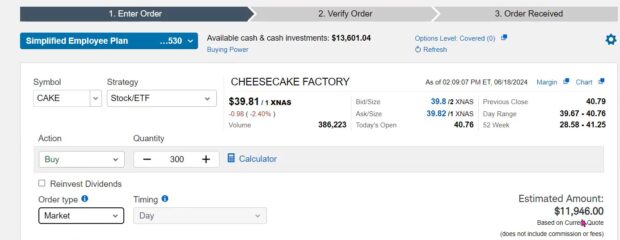
- Ticker symbol (CAKE) is entered
- Enter buy 300 shares
- Market order, day only
- Check estimated amount to make sure there is adequate cash available (red arrow)
- If all looks good, place order (not shown here)
Go to the options link of the broker platform to sell the (3) options
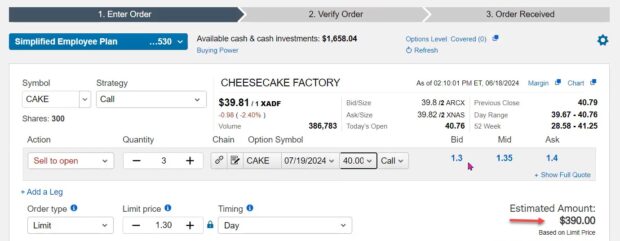
- The strategy is “call”, and we want to Sell to Open”
- 3 contracts
- $40.00 strike
- 7/19/2024 expiration
- The “bid” price is $1.30 (small red arrow)
- Make sure this return aligns with our pre-stated initial time-value return goal range
- Enter limit order at $1.30 (could be up to $1.35- below the midpoint)
- Day order
- For the 3 contracts, $390.00 (minus small commissions) will be sent to our cash account, once executed (seconds)
- After reviewing the order, it is placed, and we check to make sure that the trade has been executed. This takes seconds
Set up our 20%/10% buy-to-close, good-until-cancelled limit order to protect against share price decline
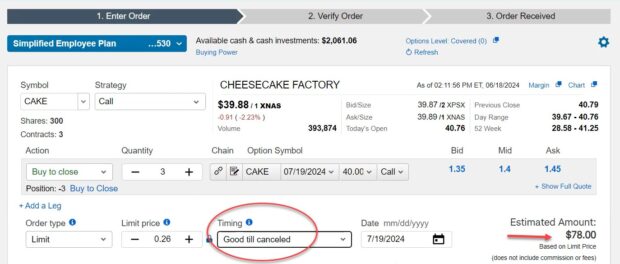
- Buy-to-close option limit order is set for 3 contracts at $0.26 (20% of $1.30)
- If the $0.26 threshold is reached, it will cost $78.00 to close the 3 contracts, minus tiny trade commission
- This will be changed to $0.13 (10% of $1.30) with 2 weeks remaining on the monthly contract
Calculating our initial returns
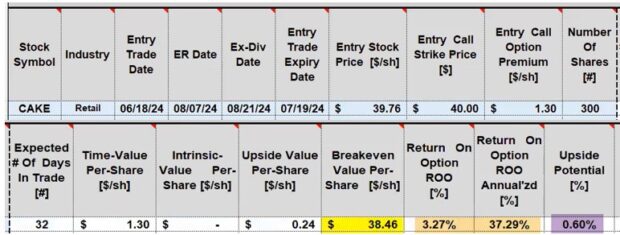
- Our Trade Management Calculator (TMC) shows a 32-day return of 3.27%, 37.29% annualized (brown cells)
- There is an additional potential of 0.60%, if share price rises to or beyond the $40.00 strike price (purple cell)
- The breakeven price point is $38.46 (yellow cell)
Discussion
To view the recording of these real-life trades, as I executed them, click here.
BCI Expected Price Movement Calculator

The Expected Price Movement Calculator is designed to generate an approximate projected trading range for the underlying security, specific for the selected contract expiration date. The at-the-money implied volatility (IV) of the stock or ETF (exchange-traded fund) is used to achieve this valuable information.
Inherent in the spreadsheet is a conversion formula that recalibrates the annualized IV stat into one specific for the contract being traded. Easily accessed option-chain data is entered into the white cells at the top of the spreadsheet and calculations will appear in the yellow cells below.
This tool will yield upper and lower ends of the trading range during the option contract being traded with an approximate 84% probability of accuracy.
To view the video and to purchase the BCI Expected Price Movement Calculator, click here.
Premium Membership Price Increase Notification: No Rate Increase for Current Members
On September 1, 2024, BCI will be raising membership rates for new members only. This will not apply to current members. It has been 3 years since we had a rate increase. In that period, we have added dozens of training videos, additional downloads and resources and more quality data to our stock and ETF reports. We are fortunate to have such a robust and expanding membership and strive to provide the best high-quality information and tools at the lowest industry prices.
This price increase will not apply to current active members as you are grandfathered into the current rate for life or as long as your membership remains active. This is our loyalty pledge to you.
The increase for new members will go into effect on September 1, 2024, as follows:
Monthly: $19.95 for the first (trial) month and $69.00 each 30-days thereafter (currently $57.95).
Annual: $778.95 for the first 13 months (includes a reduced first month and a free last month) and then $828.00 every 13 months thereafter (includes 1 free month). Currently $657.40 and $695.40.
All new members who subscribe between now and 8/31/2024 will be grandfathered into the current rate and will see no price increase on 9/1/2021.
Thanks to all our loyal members for your support over the past 17 years and for putting BCI on the financial map.
Click here for member benefits video.
Click here for membership information.
Your generous testimonials
Over the years, the BCI community has been incredibly gracious by sending our BCI team email testimonials sharing stories as to what our educational content has meant to their families. Moving forward, we have decided to publish several of these testimonials in our blog articles. We will never use a last name unless given permission:
Alan, thank you soooo much for your responses. Your personal attention and willingness to help members have exceeded my expectations. I will be a forever premium member and also have passed your name along to many others that are interested in options trading. Thanks again
Sincerely,
TOM
Upcoming events
1. Mad Hedge Investor Summit
Tuesday September 17, 2024
11 AM ET – 12 PM ET
Zoom webinar.
Portfolio Overwriting: Covered Call Writing Our Buy-And-Hold Stocks
Increasing profits and avoiding tax issues
Our buy-and-hold portfolios in non-sheltered accounts are generating 8% – 10% per year. Can we potentially increase these yields by selling stock options while, at the same time, dramatically decreasing the probability of our shares being sold to avoid potential tax implications? The answer is a resounding “yes”.
Portfolio Overwriting is a strategy that can benefit millions of investors seeking to enhance portfolio returns using a low-risk covered call writing-like strategy.
Traditional covered call writing will also be discussed to demonstrate comparisons between the 2 strategy approaches.
Topics discussed
Summary
Brief review of covered call writing
Option basics
What is an option-chain?
Option selection
Calculating covered call returns: Real-Life examples
Portfolio overwriting defined
Basics of strike selection
Pros and cons of portfolio overwriting
Why early exercise is so rare
Rolling options
Role of dividends
Locating ex-dividend dates
How to avoid early exercise
Avoiding earnings reports
Practical applications: Delta, implied volatility, annualized returns
Real-life examples with calculations
BCI Trade Management Calculator
Registration link to follow.
2. Stock Traders Expo- live event in Orlando Florida
October 17 -20
- 2-hour Covered Call Writing Masters Class
- All Stars of Options class on Portfolio Overwriting
Details to follow.
3. American Association of Individual Investors/ Los Angeles Chapter
November 9, 2024
12 PM ET – 1:30 PM ET
Private webinar for members of this AAII investment club
4. Young Investors Club: University of Central Florida
Wednesday November 13, 2024
Private investment club
5. BCI-Only Webinar
Zoom
Thursday November 21, 2024
8 PM ET – (:30 PM ET
Covered Call Writing Dividend Stocks
Details & registration link to follow.
6. Long Island Stock Investor Group Part I
Zoom
February 13, 2025
7:30 – 9:00 ET
Details to follow.
7. Las Vegas Money Show
February 17 – 19, 2025
details to follow.
8. Long Island Stock Investor group Part II
March 13, 2025
7:30 – 9:00 ET
Details to follow.

Begin additional segments text here (like testimonials, events, etc.)

Premium Members,
This week’s Weekly Stock Screen And Watch List has been uploaded to The Blue Collar Investor Premium Member site and is available for download in the “Reports” section. Look for the report dated 08/16/24.
Be sure to check out the latest BCI Training Videos and “Ask Alan” segments. You can view them on The Blue Collar YouTube Channel. For your convenience, the link to the BCI YouTube Channel is:
https://www.youtube.com/user/BlueCollarInvestor
Reminder: Premium Member’s pricing is locked into your current rate and you will never see a rate increase as long as the membership remains active.
Barry and The Blue Collar Investor Team
Alan,
3 months ago, I started selling covered calls against my long term stock holdings. I now have an income stream I never had before. Wish I started this years ago.
My question is: do you prefer to use delta or iv to set the otm call strike? Both?
Thanks for all you do.
Charlie
Charlie,
When we use implied volatility (IV), the approximate % probability of the strike NOT ending in-the-money or ITM (and subject to exercise) is 84%.
With Delta, the approximate % probability of the strike ending ITM is the Delta itself. A Delta of “10” will result in an approximate 10% probability of expiring ITM.
We ask ourselves “how much risk are we willing to incur, and will the associated strike align with our initial time-value return goal range?”.
If 84% aligns with our personal risk tolerance, go with IV. If not, Delta.
Bottom line: Both are valuable tools that offer guidance related to structuring our trades. Both should be available and in consideration.
Alan
Alan,
I have a question about your CEO strategy. It appeals to me because I have such a busy schedule (work and kids!).
In your book, you used both 4 and 5 ETFs depending on the month. Is it better to use 4 or 5 or no difference?
Thank you.
Linda
Linda,
Both have the potential to be successful.
I’d give a slight edge to 5 positions due to better diversification. Of course, the cash available is also a factor.
Alan
Alan,
Do you ever consider the amount of dividend when selecting stocks for covered call writing?
Thanks,
Bruce (premium member)
Bruce,
No. I consider dividends to be “icing on the cake”.
Our main focus is the option premium. Dividend income will pale in comparison the option premiums we generate.
Alan
Premium Members,
This week’s Weekly Stock Screen And Watch List has been revised and uploaded to The Blue Collar Investor Premium Member site and is available for download in the “Reports” section. Look for the report dated 08/16/24-RevA. The expiration date sort order has been corrected. There was no change to the actual data itself.
Be sure to check out the latest BCI Training Videos and “Ask Alan” segments. You can view them on The Blue Collar YouTube Channel. For your convenience, the link to the BCI YouTube Channel is:
https://www.youtube.com/user/BlueCollarInvestor
Reminder: Premium Member’s pricing is locked into your current rate and you will never see a rate increase as long as the membership remains active.
Barry and The Blue Collar Investor Team
Hi Alan or Barry,
I had sold a call option on ZIM with a strike price of $19 that expired on 8-16-24. The stock closed at $19.06 on 8-16-24, but the option wasn’t assigned and the stock wasn’t sold.
I called e*trade this morning and they said the option buyer can refuse buying the stock. I didn’t think that was possible.
Please give me your thoughts.
Thanks,
Guerry
Hi Guerry,
Call option buyers have the right, but NOT the obligation to buy an underlying security at a specific price within a specified time.
Call option sellers have the OBLIGATION to sell an underlying security at a specific price within a specified time.
Net/net…buyers have rights, sellers have obligations.
Best,
Barry
Alan & Barry,
Thanks so much for answering my question.
This stock announced earnings before the bell on Monday morning which were very good. The stock opened over $3 higher and I sold the same strike price (19) that I had used before for $375. This one worked out in my favor.
Thanks again.
Guerry
Guerry,
The broker rep is correct.
When strikes expire in-the-money (with intrinsic-value) exercise will occur almost always.
However, market-makers have until 5:30 PM ET on expiration Friday to make final decisions regarding exercise of options.
There are rare times when news will come out after 4 PM, but before 5:30 PM, which leads market-makers to believe the security may open lower on Monday. This may lead to non-exercise of ITM strikes … very rare.
Alan
Hi Alan,
What do you recommend as to how many options you might have open at any one time?
Tom
Tom,
There is no single answer that is appropriate for every investor.
We have members trading 2-3 positions/week or month and some who trade 50+ positions.
We must set ourselves up for success and make our approach manageable.
If you are just starting out, I suggest starting conservatively, depending on the cash available. Start small and work your way up until you find the sweet spot that is right for you.
I trade between 20 – 30 positions per month, between 75 – 125 contracts per month. Some are weekly expirations, some monthly. Some calls, some puts. However, when I first started, it was 5 positions. I, ultimately, found the appropriate number that works well for me.
Take your time and you, too, will determine the amount that will be in your best interest.
Alan
Premium members:
This week’s 4-page report of top-performing ETFs, along with our sample trade of the week, has been uploaded to your premium site. The Select Sector SPDR section is now crafted to align with our streamlined (CEO) approach to covered call writing. The report also lists Top-performing ETFs with Weekly options, mid-week market tone as well as the implied volatility of all eligible candidates.
We have also included a sample trade taken from one of our BCI watchlists.
Premium member video link:
https://youtu.be/EXMO-KwZuJs
For your convenience, here is the link to login to the premium site:
https://www.thebluecollarinvestor.com/member/login.php
NOT A PREMIUM MEMBER? Check out this link:
https://www.thebluecollarinvestor.com/membership.shtml
Alan and the BCI team
Hey Alan,
New subscriber here. Listen, hypothetically speaking is a 2% – 4% monthly portfolio return on a $50k within reason for selling covered calls?
I know that is a total crap shoot ask, much less a moving target. I’m inquiring based on your experience what is a potential (realistic) monthly expectation?
Appreciate your (hypothetical again) input.
Thanks – David
David,
Welcome to our BCI premium member community.
I set up (almost) all my monthly trades with a 2% – 4% “initial” time-value return goal range (lower in my mother’s portfolio). That’s our starting point.
At the end of the contract, our “realized” return could be higher or lower, but that’s our starting point.
Now for what to expect. When we sell options, we are lowering our cost-basis. This puts us in a position to beat the market on a consistent, many years significantly.
Much depends on the market itself. We do better in normal and bull markets. In bear markets, our returns will be lower, but we are in a position to outperform the market. This has been my experience in nearly 30 years of selling options, a game changer for me.
In my 9th book, “Covered Call Writing: A Streamlined Approach”, I took screenshots of every trade I executed over a 1-year timeframe (2022) in 1 of my portfolios. I beat the market by > 15%. However, since 2022 was such a down year for the market, I lost a little over 1%.
Covered call writing and selling cash-secured puts are wonderful strategies which are associated with low risk, not no risk. When managed properly, we put ourselves in great positions to beat the market consistently and many years, substantially.
Alan
Hi Alan,
Does the 20% 10% Exit Strategy have a different effect when you use it for ITM v. OTM options.
Tom
Tom,
The same 20%/10% guideline BTC/GTC limit orders apply to both ITM & OTM strikes.
The rationale has to do with Delta & Theta. As share price declines, option value will decline at a greater rate for ITM strikes than OTM strikes.
Bottom line: For our option-selling trades, set 20%/10% BTC/GTC limit orders no matter what the “moneyness” of the options are.
Alan